Why Your Google Ads Get Clicks But No Leads

A practical breakdown of one of the most frustrating problems in performance marketing—when Google Ads generate clicks but fail to produce leads. This guide explains why this happens, where most campaigns break down, and how to rebuild your funnel so that traffic actually turns into measurable business outcomes.
Table of Contents
Introduction: Getting Clicks but No Results
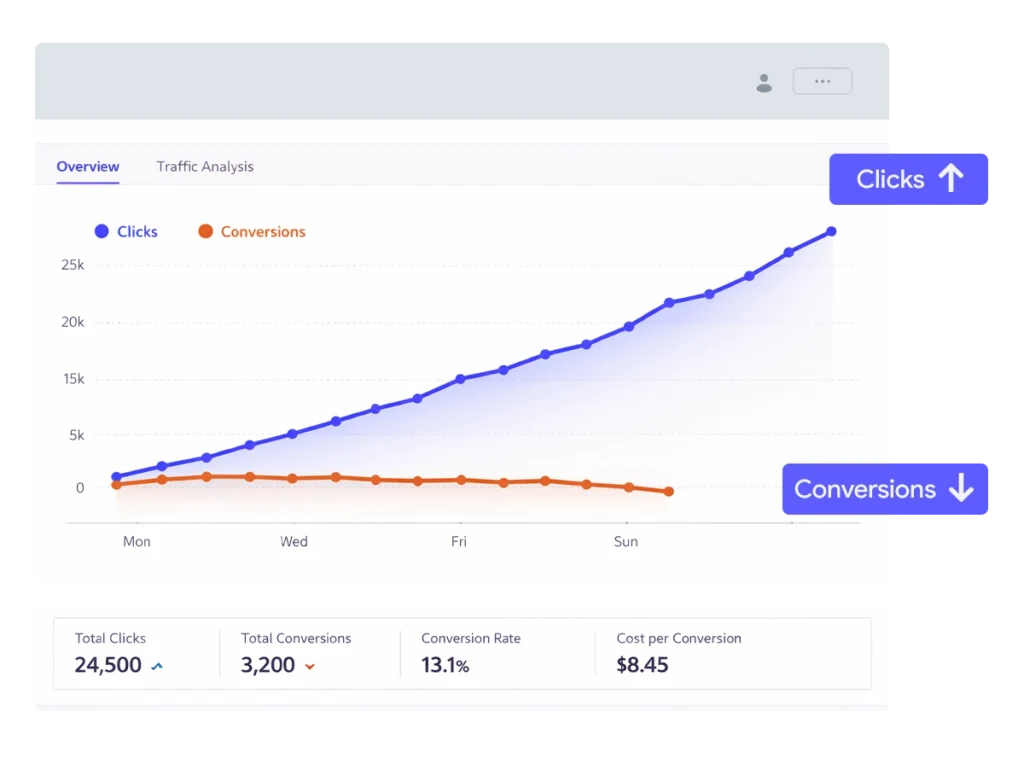
Many businesses running Google Ads experience the same confusing situation: the campaign generates consistent clicks, the cost-per-click looks reasonable, and traffic is flowing to the website, yet there are no leads or very few conversions. On the surface, the campaign appears active and even successful in terms of visibility, but the actual business outcome remains unchanged.
This gap between clicks and results is one of the most common issues in performance marketing. The problem is not always the ads themselves, but what happens after the click. In most cases, businesses focus heavily on driving traffic while ignoring the system required to convert that traffic into leads.
Understanding this disconnect is essential because clicks alone do not generate revenue—only conversions do.
What Counts as a “Lead” in Google Ads?
A lead in Google Ads is any meaningful action that indicates interest in your product or service. This could include form submissions, phone calls, WhatsApp inquiries, booking requests, or any tracked conversion event that reflects user intent.
The key point is that a lead is not just a click or a page view. It is a measurable action that moves a potential customer closer to becoming a paying client. Without proper conversion tracking, businesses often misinterpret performance and assume campaigns are underperforming when in reality, leads are simply not being captured correctly.
A clear definition of what constitutes a lead is essential before optimizing any campaign.
The Real Problem: Clicks ≠ Conversions
One of the biggest misconceptions in Google Ads is assuming that clicks are equal to progress. While clicks indicate interest, they do not guarantee intent, trust, or readiness to act. Many users click ads out of curiosity, comparison, or accidental engagement without any real intention to convert.
This is why a campaign can have strong click-through rates but still produce zero leads. The issue lies in the gap between user expectation and post-click experience.
If the landing page, offer, or messaging does not align with what the user expected from the ad, they leave without taking action. This is where most campaigns fail—not at the ad level, but after the click.
Top Reasons Your Google Ads Aren’t Converting
There are several common reasons why Google Ads generate clicks but fail to produce leads. These issues usually exist within the structure of the funnel rather than a single isolated mistake.
1. Poor Landing Page Experience
The landing page is often the biggest conversion bottleneck. If the page is slow, unclear, or not aligned with the ad message, users quickly lose interest. A weak landing page fails to reinforce trust or guide users toward a clear action, resulting in high drop-off rates.
2. Wrong Audience Targeting
Even if ads are performing well, targeting the wrong audience leads to irrelevant traffic. This often happens when keywords are too broad or when intent is not properly defined. As a result, users click but have no real need for the service being offered.
3. Weak Offer or Messaging
If the value proposition is unclear or not compelling, users have no reason to convert. Even with good traffic, a weak offer fails to create urgency or relevance. Messaging must clearly communicate what the user gains and why they should act now.
4. No Clear Call-to-Action
A missing or unclear call-to-action creates confusion. Users should always know what step to take next. Without clear direction, even interested visitors leave without converting because there is no guided path forward.
5. Tracking & Conversion Issues
Sometimes the issue is not performance but visibility. Poor tracking setup can make it appear as though no leads are coming in, even when conversions are happening. Without accurate tracking, optimization becomes guesswork rather than data-driven improvement.
How to Diagnose a Failing Google Ads Campaign
Diagnosing a failing campaign requires breaking down the entire funnel into stages rather than focusing only on ad performance. The first step is to analyze whether clicks are coming from relevant audiences with real intent.
Next, the landing page experience should be evaluated for clarity, speed, and alignment with ad messaging. After that, conversion tracking must be checked to ensure all leads are being recorded accurately.
Finally, user behaviour should be analysed to identify where drop-offs occur. This helps pinpoint whether the issue lies in targeting, messaging, or post-click experience.
What a High-Converting Google Ads Funnel Looks Like
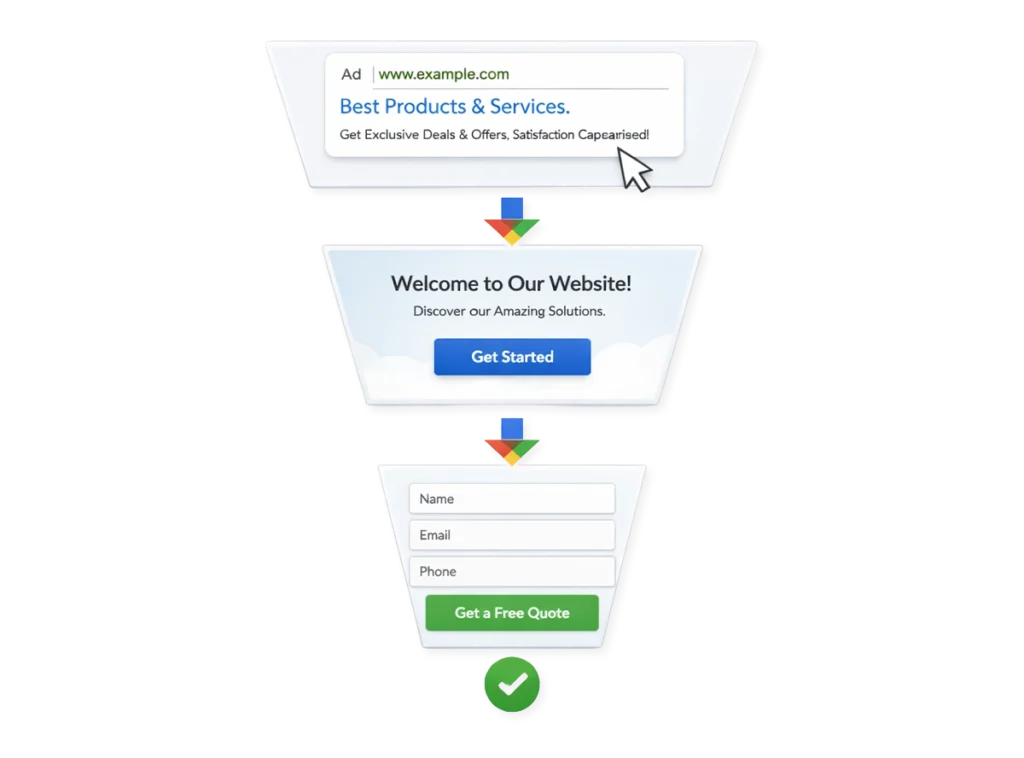
A high-performing Google Ads system is not just an ad campaign—it is a structured funnel that guides users from interest to conversion in a seamless flow.
The process begins with a targeted ad that attracts users with clear intent. Once they click, they are directed to a landing page that reinforces the message and builds trust. From there, a clear conversion path leads users to take action such as filling out a form or making an inquiry.
Quick Fixes You Can Apply Today
Improving Google Ads performance does not always require a complete overhaul. Small adjustments can significantly improve conversion rates when applied correctly.
One of the most effective fixes is aligning ad messaging with landing page content to ensure consistency in user expectations. Improving page speed and simplifying the landing page layout can also reduce bounce rates.
Refining targeting by narrowing keyword intent and adding negative keywords helps filter out irrelevant traffic. Strengthening calls-to-action and making them more visible can also improve user engagement and conversion likelihood.
When You Need a Full Strategy Reset
In some cases, quick fixes are not enough. If multiple layers of the funnel are misaligned, a full strategy reset is required. This typically happens when ads, landing pages, and messaging are all disconnected or when tracking is incomplete.
A full reset involves rebuilding the funnel from the ground up, starting with audience definition, followed by offer clarity, landing page structure, and campaign alignment. This ensures that every part of the system works together rather than independently.
Without this alignment, performance will continue to fluctuate regardless of budget increases.
Conclusion: It’s Not About More Traffic
The most common mistake in Google Ads is assuming that more traffic will automatically lead to more leads. In reality, traffic without conversion structure is just cost without return.
Successful campaigns are not defined by clicks, but by how effectively those clicks are converted into business outcomes. When targeting, messaging, landing pages, and tracking are properly aligned, even modest traffic can produce strong results.
Ultimately, the goal is not to get more clicks—it is to build a system where every click has a clear path to conversion.