
Why Your Business Needs a Unified Digital Strategy:
Turning Fragmented Marketing into a Growth System
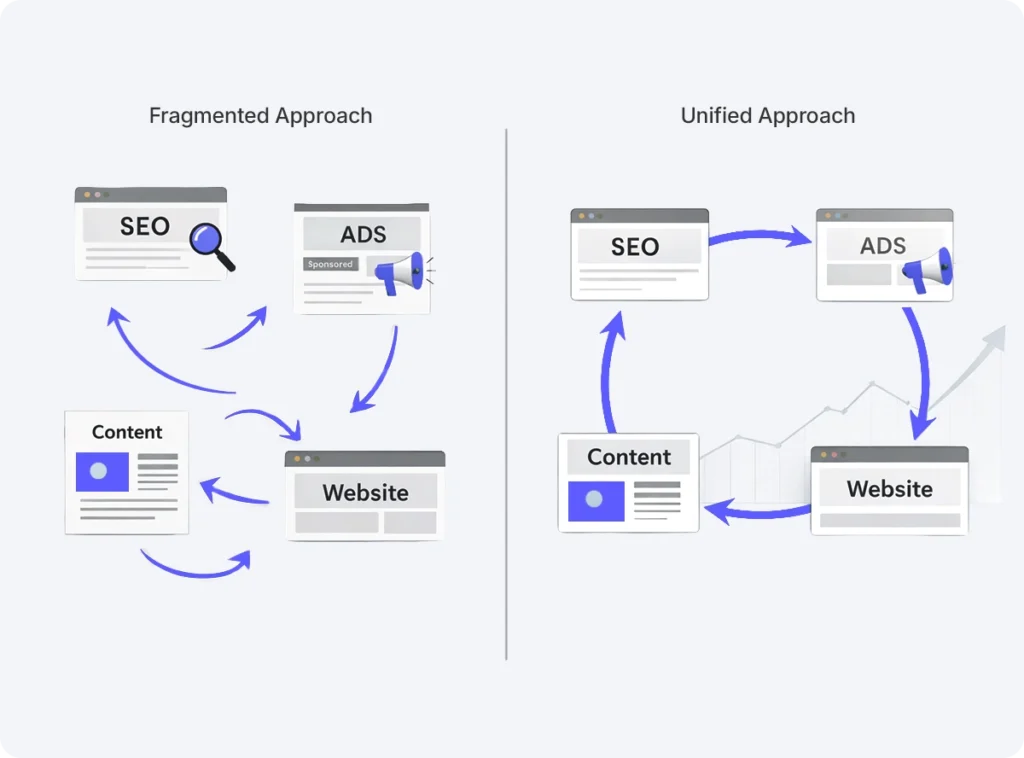
A strategic breakdown of why most businesses struggle with inconsistent marketing results and how a unified digital strategy transforms disconnected efforts—such as SEO, ads, content, and websites—into a single performance-driven system that improves clarity, efficiency, and long-term ROI.
Introduction: Fragmented vs Unified Marketing
Most businesses today are active in digital marketing, but very few are actually coordinated. It is common to see companies running Google Ads campaigns in one direction, publishing social media content in another, and maintaining a website that does not reflect either of those efforts. On the surface, everything appears active, but internally, the system is fragmented, leading to inconsistent results and unclear performance outcomes.
This fragmentation creates a situation where marketing becomes a collection of isolated activities rather than a connected growth engine. Businesses may generate traffic, engagement, or visibility, but struggle to convert these into predictable leads or revenue. The issue is not effort—it is alignment. Without a unified structure, even strong marketing channels fail to work together effectively.
A unified digital strategy solves this problem by connecting every touchpoint in the customer journey, ensuring that ads, content, SEO, and website experience all work toward the same business objective instead of competing for attention in different directions.
What Is a Unified Digital Strategy?
A unified digital strategy is a structured approach where all marketing channels and digital assets operate under a single, cohesive system. Instead of treating SEO, paid ads, content marketing, and website design as separate initiatives, they are integrated into one coordinated framework that supports a shared conversion goal.
This means that every piece of content, every ad campaign, and every landing page is designed with a clear understanding of how it fits into the broader customer journey. The messaging remains consistent, the targeting is aligned, and the user experience flows logically from awareness to conversion without friction.
At its core, a unified strategy is not about doing more marketing—it is about making all existing marketing efforts work together in a structured and measurable way.
Problems with Disconnected Marketing Efforts
When marketing efforts operate in silos, businesses often experience inefficiency at multiple levels. One of the most common issues is inconsistent messaging across platforms, where ads promise one thing while landing pages or website content communicate something different. This creates confusion for users and reduces trust, which directly impacts conversion rates.
Another major problem is wasted budget allocation. For example, businesses may invest heavily in paid advertising without ensuring their website is optimized for conversions, resulting in high traffic but low lead generation. Similarly, SEO efforts may bring in organic traffic that does not match the intent of the business’s core offering.
Disconnected systems also make performance tracking difficult. When data is spread across multiple unaligned channels, it becomes challenging to understand what is actually driving results. This often leads to incorrect decisions, such as scaling the wrong campaigns or optimizing the wrong pages.
Benefits of a Unified Approach
A unified digital strategy creates structure, clarity, and predictability in marketing performance. Instead of relying on isolated wins, businesses begin to operate as a coordinated system where each channel reinforces the others.
1. Consistency
Consistency is one of the most important advantages of a unified system. When messaging, branding, and positioning remain aligned across ads, website pages, and content, users develop stronger trust in the business. This consistency reduces cognitive friction and helps potential customers move more smoothly through the decision-making process.
2. Efficiency
Efficiency improves significantly when all marketing components are aligned. Instead of duplicating efforts across different teams or platforms, businesses can reuse insights, messaging frameworks, and content structures across multiple channels. This reduces operational waste and ensures that every action contributes to a shared objective.
3. Better ROI
Return on investment improves when traffic, conversion, and messaging systems are working together. A unified approach ensures that every click has a higher chance of converting because the user journey is designed with intention. Instead of spending more to fix underperformance, businesses achieve better results from existing traffic and campaigns.
Key Components of a Unified System
A unified digital strategy is built on four core components that must work together seamlessly to create a complete growth ecosystem.
Website
The website acts as the central conversion hub in any digital system. It is where all traffic eventually converges, whether from ads, SEO, or social media. A unified strategy ensures that the website is not just visually appealing but also structurally optimized to guide users toward action through clear messaging, logical flow, and strong calls-to-action.
Ads
Advertising platforms such as Google Ads or social media ads are responsible for driving targeted traffic into the system. In a unified approach, ad messaging is directly aligned with landing page content to ensure continuity of intent. This reduces bounce rates and improves conversion rates by setting accurate expectations before the click even happens.
Content
Content marketing plays a crucial role in building authority and supporting SEO and AEO visibility. In a unified system, content is not created randomly but is strategically designed to support search intent, answer customer questions, and guide users toward conversion-oriented pages. This ensures that content contributes directly to lead generation rather than just traffic generation.
Analytics
Analytics is the backbone of optimization in a unified strategy. Without proper tracking and data interpretation, it is impossible to understand user behavior or identify performance gaps. A unified system relies on structured analytics to monitor the entire customer journey, from first interaction to final conversion, enabling continuous improvement based on real data.
Example: Unified vs Scattered Business
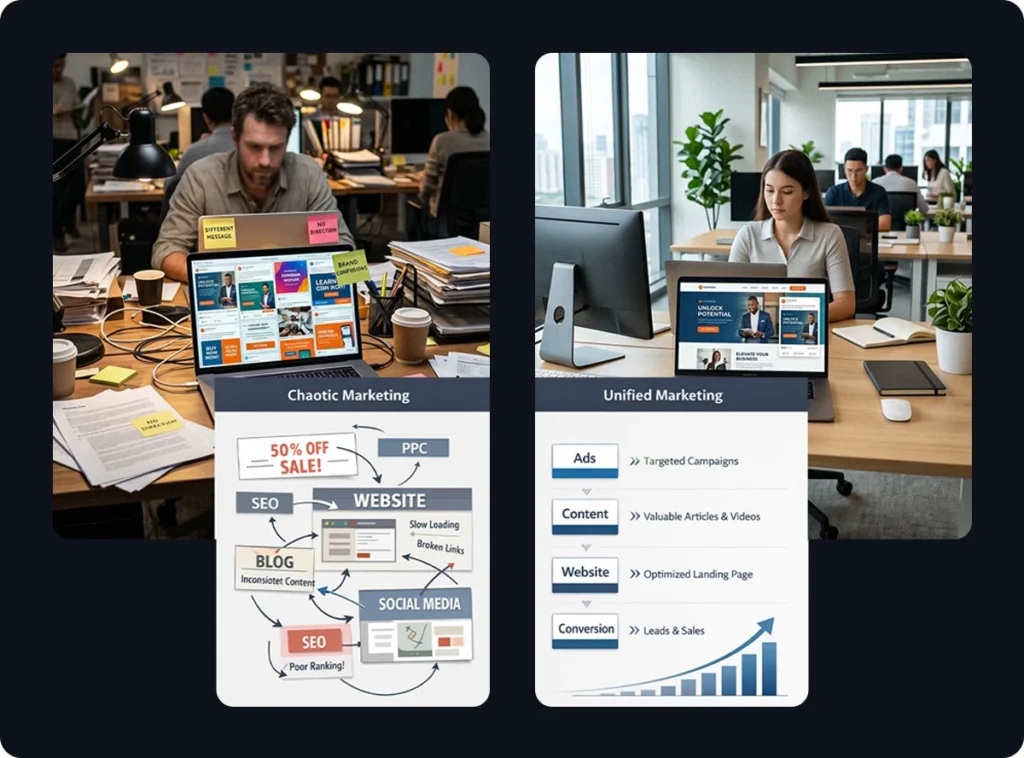
In a scattered marketing setup, a business may run ads with one message, publish content unrelated to those ads, and maintain a website that does not reflect either channel. As a result, users experience inconsistency at every touchpoint, leading to confusion and lower conversion rates.
In contrast, a unified system ensures that a user sees a consistent message from the first ad impression to the final landing page interaction. The messaging is aligned, the experience is seamless, and the conversion path is clearly defined. This creates a structured flow where every marketing element reinforces the others instead of working independently.
How to Build a Unified Strategy
Building a unified digital strategy begins with aligning business goals across all marketing channels. The first step is to define a clear value proposition and ensure it is consistently communicated across ads, website content, and SEO efforts. Once messaging is aligned, the next step is to structure the website as a conversion-focused system rather than just an informational platform.
After this foundation is in place, traffic sources such as paid ads and SEO should be adjusted to match the same intent and messaging framework. Finally, analytics systems must be implemented to track user behavior across the entire journey, allowing for continuous refinement and optimization.
This process is not a one-time setup but an ongoing system of alignment and improvement.
Why Most Businesses Fail to Do This
Most businesses fail to build a unified digital strategy because they treat marketing as separate tasks rather than a connected system. Different teams or vendors often manage SEO, ads, and website development independently, which leads to misalignment in execution.
Another major reason is the focus on short-term results instead of long-term structure. Businesses often prioritize immediate traffic or leads without addressing foundational issues such as messaging clarity or conversion design. This leads to temporary gains but inconsistent long-term performance.
Lack of strategic oversight is also a key factor. Without a central framework guiding all digital activities, marketing becomes reactive rather than intentional, which limits scalability.
Conclusion: Integration Is the Future
The future of digital marketing is not about isolated channel optimization but about system-wide integration. Businesses that continue to treat SEO, ads, content, and websites as separate functions will struggle to achieve consistent and scalable growth.
A unified digital strategy brings structure to complexity by ensuring that every marketing effort contributes to a single, measurable objective. When all components work together, marketing becomes more predictable, more efficient, and significantly more impactful.
For businesses aiming to grow sustainably in an increasingly competitive digital landscape, integration is no longer optional—it is the foundation of modern performance marketing.