Freelancer vs Agency : What Actually Helps You Grow?

If you’re deciding between freelancer vs agency for your marketing needs, you want work that scales, delivers consistent results, and aligns with business goals. Choosing a freelancer can feel cheaper and faster at first, but agencies offer systems, cross-functional teams, and accountability that usually drive sustainable growth. Below is a clear breakdown to help you choose the right path for long-term marketing impact.
If you’re deciding between a freelancer vs agency for your marketing needs, the right choice depends on your growth goals, timeline, and the systems you need to scale. This guide walks through the practical trade-offs cost, speed, expertise, and long-term impact so you can pick the approach that actually helps you grow.
Table of Contents
Why the Freelancer vs Agency Decision Matters Early
Picking between freelancer vs agency affects speed, quality, and the scope of what you can achieve. Freelancers excel at discrete tasks copy, design, or a one-off campaign while agencies provide end-to-end programs: strategy, execution, measurement, and ongoing optimization. If growth matters beyond short-term fixes, the difference becomes strategic, not merely transactional.
1. Capability and team depth
Freelancers bring deep skill in a particular area, but you’ll often need several freelancers to cover SEO, content, design, paid media, and analytics. Managing multiple specialists increases coordination overhead and time to market. Agencies bundle those capabilities under one roof, delivering coordinated campaigns that align messaging, targeting, and measurement. For companies aiming to scale, that integrated approach typically outperforms a patchwork of individual contractors.
2. Consistency and systems
One reason organizations shift from freelancer to agency is systems. Agencies develop repeatable processes content calendars, QA workflows, reporting templates that ensure consistent output. Freelancers may deliver great work, but consistency can vary with availability, bandwidth, and differing approaches. If your growth plan depends on predictable volume and quality, an agency’s systems reduce risk and maintain momentum.
3. Strategy and long-term thinking
Freelancers are often task-focused: write this blog, run this ad. Agencies are strategy-first, designing programs that connect channels and prioritize high-impact opportunities. When you choose an agency, you get a partner that asks about targets, audience segments, LTV, and how marketing ties to sales. That perspective shifts work from isolated deliverables to measurable business outcomes.
4. Accountability and reporting
Agencies typically provide structured reporting and regular strategy reviews. When you rely on multiple freelancers, synthesizing results into an actionable dashboard becomes your responsibility. Agencies own performance meetings, optimization cycles, and accountability for agreed KPIs making it easier to iterate and scale what works.
Cost: Short-term vs Long-term ROI
Freelancers can be cost-effective for one-off tasks or early-stage experiments. However, agencies often deliver better long-term ROI by reducing costly mistakes, accelerating time-to-value, and capturing synergies across channels. Consider the true cost: the time your internal team spends managing contractors, the missed opportunities from disjointed campaigns, and the slower path to measurable growth.
When a freelancer makes sense
- You need a specific skill for a short-term project.
- You have strong internal project management and a clear brief.
- Budget constraints prevent engaging an agency right now, and you accept trade-offs on coordination and scale.
When an agency is the better choice
- You need a coordinated growth plan across content, SEO, paid, and UX.
- You want predictable, repeatable results with ongoing optimization.
- You value strategic partnership, reporting, and a single point of accountability.
Small case example
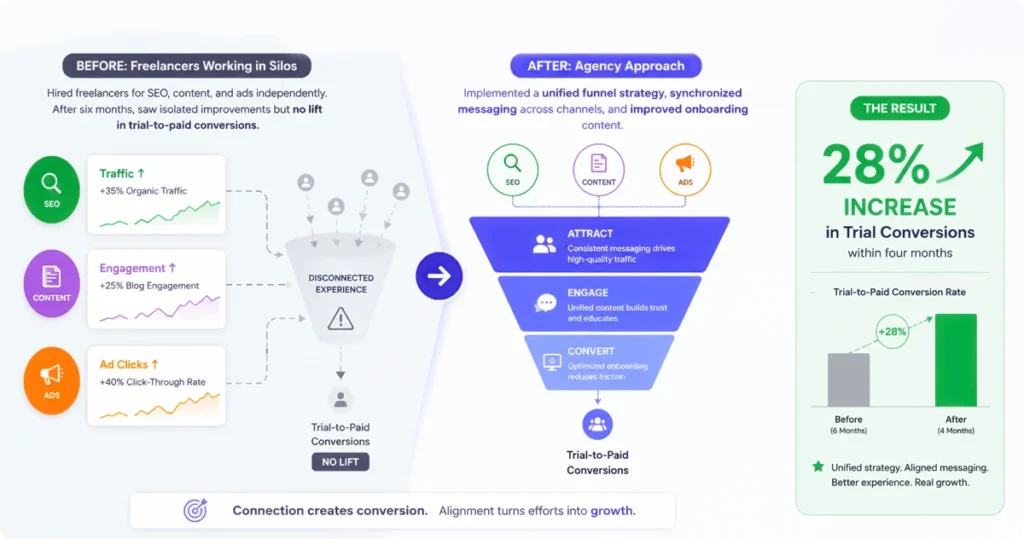
A mid-market SaaS company hired freelancers for SEO, content, and ads independently. After six months they saw isolated improvements but no lift in trial-to-paid conversions. Switching to an agency approach, the team implemented a unified funnel strategy, synchronized messaging across channels, and improved onboarding content resulting in a 28% increase in trial conversions within four months.
Final checklist for your decision
✅ Define your growth horizon: short experiment vs scale over 12+ months.
✅ Map the capabilities needed and whether one person can cover them.
✅ Estimate internal management time for coordinating freelancers.
✅ Ask agencies for case studies that match your industry and goals.
✅ Pilot a small agency engagement before committing to a longer-term retainer.
How Luniea helps
Luniea combines strategic planning, cross-channel execution, and measurable reporting to accelerate growth. If your choice is freelancer vs agency and you want a partner that delivers predictable results at scale, Luniea brings the systems and team to make that happen.
Contact Luniea today let us build the growth system your business needs.