Why You Should Track Calls and Forms, Not Just Website Visits
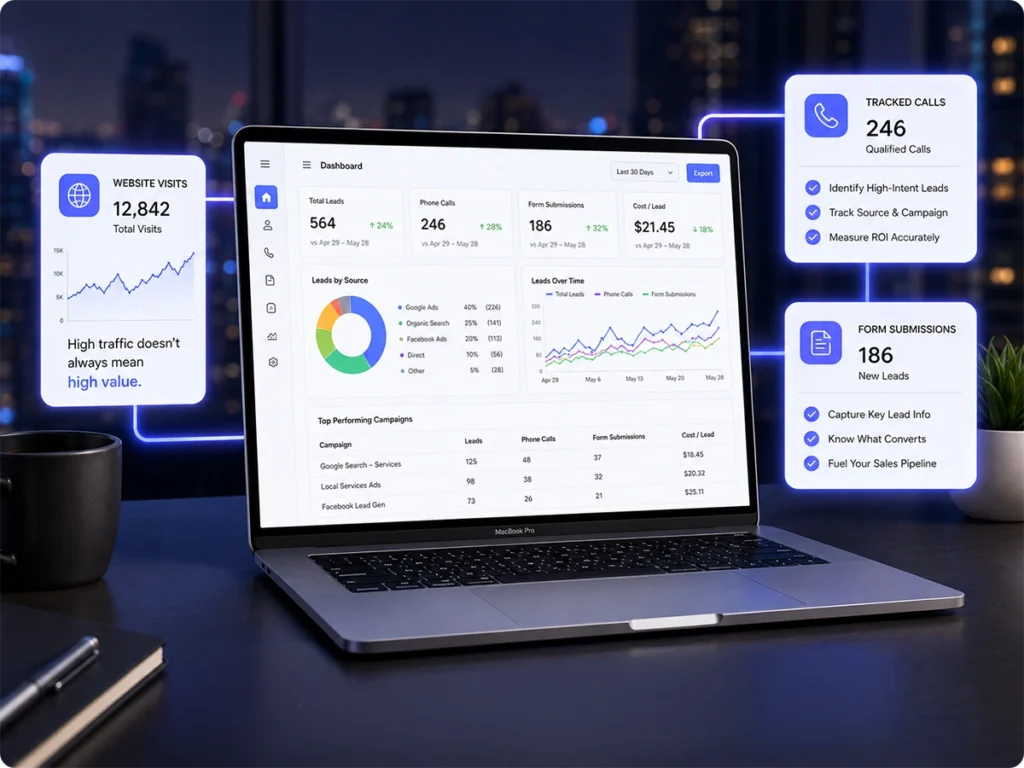
A campaign report showing thousands of website visits looks impressive, right up until you realize none of it tells you whether those visits actually turned into customers. For a huge number of local and service-based businesses, the real conversion doesn’t happen on the website at all. It happens on the phone, or in a form submission that gets followed up by an actual person. If you’re only tracking visits, you’re measuring activity, not results.
Invoca’s 2026 survey of US and UK consumers found that over 40 percent prefer calling a business when they have a problem and need help, more than any other channel, and that preference has held steady for years. Google itself notes that phone calls and form submissions are core conversion types in its own tracking tools, alongside purchases, because they represent the customer actions that actually matter to a business. This guide explains why tracking calls and form submissions matters far more than website traffic alone, how the tracking actually works behind the scenes, and what it takes to set it up properly so your marketing decisions are based on real outcomes instead of surface-level numbers.
Table of Contents
The Core Problem With Tracking Visits Alone
Website visits measure exposure, not outcomes. Someone visiting your site tells you they were interested enough to click, but it tells you nothing about whether they actually became a customer. For businesses where the real conversion happens off the website entirely, a phone call, an in-person visit, a form that leads to a sales conversation, tracking visits alone leaves out the part of the story that actually matters to your bottom line.
This creates a specific, costly problem with paid advertising in particular. When the only signal you’re feeding into your ad platforms is a website visit or a generic form submission, the system optimizes for generating more of exactly that, regardless of whether those actions ever turn into paying customers. A campaign can look highly successful by visit count while quietly producing almost no real business.
Why Phone Calls Matter So Much for Local Businesses
For a huge share of local service businesses, plumbers, dentists, lawyers, contractors, salons, the phone call is the actual conversion, not a website form. Someone searching for an urgent repair or a same-day appointment is often far more likely to just call than to fill out a contact form and wait for a response.
This means a business that only tracks website actions is often blind to its single most valuable conversion type. A campaign or keyword that drives plenty of calls but very few form submissions can look like it’s underperforming in a dashboard that only counts forms, when it may actually be one of the strongest performers in the entire account.
How Call Tracking Actually Works
The mechanics are more straightforward than they sound. According to Google’s own help documentation on offline conversion imports, importing call conversion information into Google Ads lets you track which of your ads and keywords result in the most sales calls for your business, using a dedicated forwarding number tied to your tracking setup.
Here’s the general process:
Step 1: A unique tracking number gets generated. Depending on the setup, your website might dynamically show a different phone number to different visitors, based on which campaign or even which keyword brought them there.
Step 2: The visitor calls that number. The call gets forwarded seamlessly to your real business line, so the customer experience is completely unaffected.
Step 3: The call gets logged and attributed. Because the number was tied to a specific source, the system can tell you exactly which campaign, keyword, or even which ad led to that specific call.
Step 4: That data can flow back into your ad platforms. Once a call is logged as a conversion, that information can be imported into Google Ads or other platforms, letting their bidding systems optimize toward actual calls rather than just clicks.
There’s also a simpler, lower-tech version worth knowing about for businesses that just want a basic signal: tracking length and timing of calls coming through a single number tied to your website, without the dynamic number-swapping setup. It’s less precise about exactly which keyword drove the call, but it still tells you far more than visit counts alone.
Why Form Tracking Needs More Than a Simple “Submitted” Count
A raw count of form submissions feels like useful data, but on its own it’s surprisingly thin. A form submission only tells you someone filled out a field and clicked a button. It says nothing about whether that person was a genuinely interested customer or someone who never responded to your follow-up at all.
What actually closes this gap is connecting form submissions to what happens afterward, ideally through your CRM or sales process. When a lead later becomes a real customer, that outcome can be uploaded as a conversion event, separately from the original form submission, so your tracking reflects actual sales rather than just contact attempts. This is part of a broader category Google refers to as enhanced conversions for leads, an upgraded version of offline conversion import that uses customer-provided data to connect real-world outcomes, signed contracts, completed sales, back to the original online interaction that started the journey.
Without that connection, a campaign generating a high volume of low-quality form submissions can look successful purely on volume, while a campaign generating fewer but much higher-quality leads looks comparatively weak, even though it’s the one actually producing customers.
What You’re Missing Without This Data
A few concrete examples of what stays invisible without call and form tracking in place:
- Which keywords actually drive calls, as opposed to just clicks, which matters enormously for businesses where calls are the primary conversion path
- Which campaigns produce real customers, rather than just leads that never convert into paying business
- Whether your follow-up process is the actual bottleneck, since a healthy number of quality leads going nowhere often points to a sales process problem rather than a marketing one
- The true cost per customer, rather than the more superficial cost per click or cost per form submission, which can look efficient while still producing poor actual results
This is the same underlying idea covered in our guide on why small businesses need analytics at all: the goal isn’t collecting more data for its own sake, it’s being able to answer specific, useful questions about what’s actually working.
How This Connects to Smarter Ad Spend
Modern bidding systems, including automated strategies in Google Ads, rely heavily on the conversion signals you give them. If the only signal available is a website visit or a generic form fill, that’s exactly what the system will optimize toward producing more of, regardless of lead quality.
Feeding in call and form-to-customer data changes what the algorithm is actually chasing. Instead of optimizing for more form fills, it can optimize toward the keywords, audiences, and campaigns that historically produce calls that convert and leads that actually close. This is one of the more underused levers available inside a well-managed paid search account, since most of the technical setup for it goes unused by businesses that have never connected their offline outcomes back into their ad platforms.
Setting This Up the Right Way
A practical approach for getting this in place without overcomplicating it:
- Set up dedicated call tracking numbers if phone calls are a meaningful part of how customers reach you, rather than relying on a single static number with no attribution.
- Define what actually counts as a valuable form submission, distinct from a raw count, ideally tied to whether that lead became a real conversation or customer.
- Connect your CRM or sales process to your tracking setup, even if that connection starts as a simple manual monthly upload rather than a fully automated pipeline.
- Feed real conversion data back into your ad platforms, so automated bidding optimizes toward actual business outcomes rather than surface-level actions.
- Review call and form quality regularly, not just the volume, since a steady stream of forms or calls that never convert is a signal worth investigating rather than ignoring.
Common Mistakes Businesses Make Here
Treating every form submission as equally valuable. A single spam-filled contact form and a genuinely interested customer inquiry look identical in a basic count, even though they mean completely different things for your business.
Never connecting tracking numbers to specific campaigns. A single generic tracking number across your whole site tells you that calls are happening, but not which marketing effort is actually responsible for them.
Stopping at lead volume instead of following through to actual sales. This is the single biggest gap between businesses that track calls and forms properly and those that just count them. The number that matters is how many of those leads actually became paying customers.
Assuming this only matters for big businesses. Even a small, local business with a modest ad budget benefits significantly from knowing whether its leads are calls or forms, and whether either one is actually converting into real business.
Want Help Setting Up Tracking That Reflects What Actually Matters?
Most businesses have some form of tracking running, but it usually stops at visits or basic form counts, missing the calls and the actual sales outcomes that tell the real story. We can help you set up call tracking and connect it properly to your ad accounts and CRM, so your marketing decisions are based on real customers, not just clicks.
Book a Strategy Session and we’ll take a look at what’s currently being tracked and what’s missing.
FAQs: Tracking Calls and Forms
Does call tracking change the customer experience at all?
No. The forwarding happens seamlessly behind the scenes. The customer dials a number shown on your website and reaches your actual business line without any noticeable difference.
Is call tracking only useful for businesses with high call volume?
No. Even a modest number of calls, if they represent a meaningful share of your actual conversions, is worth tracking properly. The value comes from knowing which marketing efforts produce calls, not from the raw volume of calls itself.
How do I know if a form submission actually turned into a customer?
This requires connecting your form data to whatever happens next in your sales process, typically through your CRM, so that an eventual sale or signed contract can be tracked back to the original form submission and the campaign that drove it.
Can this data actually improve my Google Ads performance?
Yes. Feeding real call and sales outcome data back into Google Ads gives automated bidding systems a much more accurate signal to optimize toward, shifting budget toward what actually produces customers rather than just clicks or generic form fills.
Do I need expensive software to set this up?
Not necessarily. Basic call tracking and CRM-to-ad-platform connections can often be set up with modest, widely available tools. The bigger barrier for most businesses is simply never having set it up at all, not the cost of the tools themselves.
What’s the very first step if I have none of this in place yet?
Start with call tracking if phone calls are a meaningful part of how customers reach you, since it’s usually the single biggest blind spot for local and service-based businesses that only track website visits.
Want a clear picture of what’s happening after someone calls or fills out a form on your site? Contact Luniea today and we’ll help you set up tracking that actually tells the full story.