Fixing a Dead Ad Campaign: A Complete Case Breakdown on Turning Clicks into Leads with Smarter PPC Optimization

A practical breakdown of how a “click-heavy but conversion-empty” Google Ads campaign was diagnosed, rebuilt, and transformed into a structured lead generation system through precise targeting, messaging alignment, landing page refinement, and tracking corrections.
Table of Contents
Introduction: What Is a “Dead Campaign”?
A “dead campaign” in digital marketing doesn’t always mean the ads have stopped running or the budget has been exhausted. In most real-world scenarios, it refers to a campaign that appears active on the surface but produces no meaningful business outcome. You may still see impressions, clicks, and even strong traffic numbers, yet the most important metric—qualified leads—remains absent or inconsistent. This creates a misleading sense of performance where data looks healthy, but revenue impact is completely disconnected.
In performance marketing systems like Google Ads or Meta Ads, this problem is more common than most businesses realize. The issue is rarely just “bad ads.” Instead, it usually signals a breakdown somewhere in the funnel—between audience intent, message alignment, landing page experience, or conversion tracking accuracy. For agencies like Luniea, these situations are not treated as failures but as diagnostic opportunities to rebuild the entire acquisition system into something predictable and scalable.
Understanding a dead campaign requires thinking beyond clicks and CPC. It requires evaluating how effectively attention is being converted into action. Once this mindset shift happens, optimization becomes structured rather than reactive, and that is where real performance transformation begins.
Campaign Overview (Scenario Setup)
The campaign in this case was part of a lead generation setup for a service-based business aiming to attract inquiries through Google Search Ads. The objective was simple on paper: generate consistent, qualified leads at a sustainable cost per acquisition while maintaining steady traffic flow to the landing page.
At the initial stage, the campaign structure appeared correctly configured. Keywords were active, ads were being served, and click-through rates were within a reasonable range for the industry. Traffic volume was also stable, which initially gave the impression that the campaign was functioning as expected. However, despite consistent clicks over several days and weeks, lead submissions remained either extremely low or completely absent.
This disconnect created uncertainty in performance evaluation. The business could see spend being utilized efficiently on the surface, but there was no proportional return in terms of inquiries, form submissions, or calls. This is a classic indicator that the funnel is breaking after the click stage, which requires deeper diagnostic analysis rather than surface-level ad adjustments.
The Problem: Clicks but No Leads
When a campaign generates clicks but fails to produce leads, the issue is rarely isolated to a single factor. Instead, it typically reflects a misalignment across multiple components of the conversion system. In this case, traffic quality and conversion intent were not aligned with the landing page experience and offer structure.
Users were clicking on ads because the messaging was relevant enough to trigger interest, but once they landed on the page, they were not compelled enough to take action. This gap between expectation and experience is one of the most common causes of underperforming paid campaigns. It often leads to high bounce rates, low engagement, and ultimately zero or minimal conversions despite healthy traffic metrics.
The challenge here was not visibility. The challenge was conversion friction—where every additional step or unclear message reduced the likelihood of a user becoming a lead.
Step-by-Step Diagnosis
Instead of making random changes, the campaign was broken down into four core diagnostic layers: targeting, ad copy, landing page experience, and tracking integrity. Each layer was evaluated independently to identify where the funnel was collapsing.
1. Targeting Issues
The first layer of analysis focused on audience intent and keyword targeting. While the campaign was attracting clicks, not all clicks were coming from high-intent users. Some keywords were too broad, which introduced irrelevant traffic that had informational intent rather than commercial intent. This meant users were exploring rather than actively looking to convert.
Another issue was the lack of strong negative keyword filtering. Without proper exclusions, the campaign was unintentionally appearing for searches that were loosely related to the service but not aligned with purchase intent. This diluted traffic quality and increased the number of unqualified visitors entering the funnel.
The result was a mismatch between what the business offered and what users were actually searching for, which is one of the most critical reasons why lead generation campaigns fail even when they receive significant traffic.
2. Ad Copy Problems
The second layer of analysis revealed a messaging gap between the ads and the landing page. While the ads were attracting attention, they were not setting accurate expectations about what the user would find after clicking. In some cases, the ads were too generic and lacked a strong value proposition, which meant users clicked out of curiosity rather than intent.
Effective PPC ad copy must do more than generate clicks; it must pre-qualify the user. In this case, the messaging did not clearly communicate what made the service different, what outcome the user could expect, or why they should act immediately. This created curiosity-driven traffic instead of decision-ready traffic.
When ad messaging is misaligned, even high-quality landing pages struggle to convert because users arrive without the right expectations or urgency.
3. Landing Page Issues
The landing page was identified as one of the strongest bottlenecks in the entire funnel. While visually acceptable, it lacked conversion-focused structure. The messaging did not immediately reinforce the promise made in the ad, which created a cognitive gap for the visitor.
Users today make decisions within seconds, especially in paid traffic environments. If the landing page does not instantly confirm relevance and value, they leave without engaging further. In this case, the call-to-action placement was not prominent enough, and the page did not guide users through a clear decision-making path.
Additionally, the content structure was more informational than persuasive. Instead of focusing on outcomes, benefits, and trust-building signals, it leaned heavily on general descriptions. This weakened the page’s ability to convert traffic into leads.
4. Tracking Gaps
The final diagnostic layer uncovered issues in tracking setup. While clicks were being recorded accurately, conversion tracking was not fully optimized. Some micro-conversions were not being captured, which made it difficult to understand user behavior between click and exit.
Without proper tracking, optimization becomes guesswork. Businesses often assume campaigns are failing when in reality, conversions are happening but not being recorded correctly. In this case, the lack of detailed funnel tracking limited visibility into drop-off points, making it harder to optimize effectively in the early stages.
Once tracking clarity improves, decision-making becomes significantly more precise, allowing for data-driven optimization instead of assumptions.
What We Changed
Once the diagnosis was complete, the campaign was rebuilt with a structured optimization approach focused on alignment across all funnel stages. Keyword targeting was refined to prioritize high-intent search terms, while irrelevant traffic sources were eliminated through an expanded negative keyword list.
The ad copy was rewritten to improve clarity, relevance, and expectation setting. Messaging was adjusted to focus more on outcomes rather than general service descriptions, ensuring that users arriving on the landing page had a clearer understanding of what they were getting.
The landing page was restructured to improve flow, starting with a stronger headline alignment, followed by benefit-driven content and clearer call-to-action placement. Trust elements such as proof points and structured value communication were enhanced to reduce hesitation.
Finally, conversion tracking was corrected and expanded to capture more detailed user interactions, allowing for more accurate performance measurement and future optimization cycles.
Results After Optimization
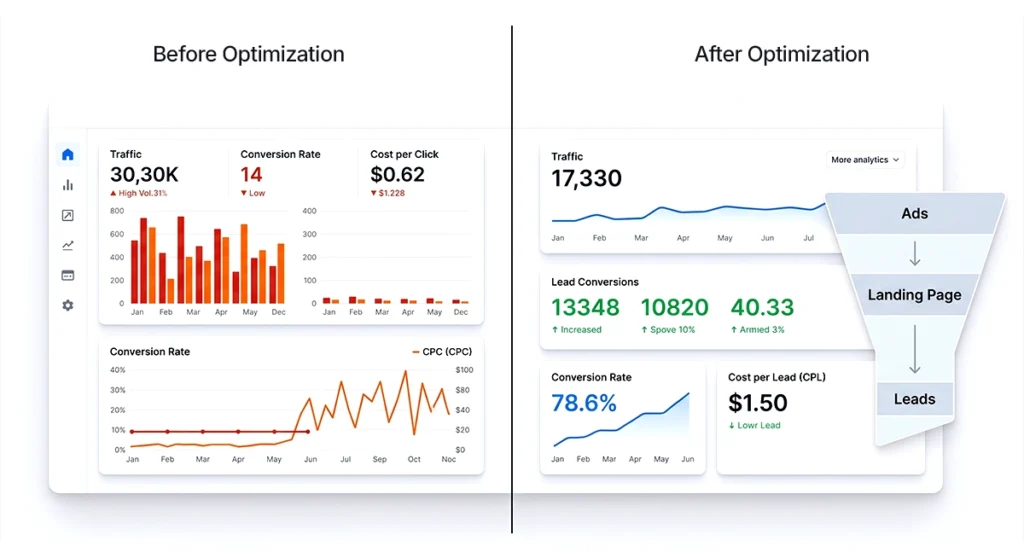
After implementing these changes, the campaign shifted from a traffic-heavy, low-conversion structure to a more balanced and performance-driven system. While click volume remained stable, the quality of traffic improved significantly, leading to a noticeable increase in lead submissions and engagement on the landing page.
More importantly, the campaign became measurable in a meaningful way. Instead of relying solely on clicks, the focus shifted toward conversion rate, cost per lead, and funnel behavior. This allowed for continuous optimization based on real user actions rather than surface-level metrics.
The key transformation was not just in numbers but in clarity. The campaign evolved from being a “guess-based ad spend” system into a structured lead generation engine.
Key Lessons from This Case
One of the most important insights from this case is that performance issues in digital advertising rarely come from a single cause. They emerge from misalignment between multiple layers of the funnel. Even when one part of the system appears strong—such as traffic volume—the overall outcome can still fail if conversion alignment is missing.
Another key lesson is that clicks are not a success metric on their own. They are only meaningful when they represent qualified intent. Without proper targeting and messaging alignment, clicks can actually become a distraction metric that hides deeper performance issues.
Finally, tracking is not optional in modern performance marketing. Without accurate data, optimization becomes subjective, and subjective decisions rarely lead to scalable results in paid advertising environments.
How You Can Apply This to Your Business
For businesses running Google Ads or any paid acquisition channel, this case highlights the importance of treating your marketing system as a connected funnel rather than isolated components. Every stage—from keyword selection to landing page experience—must work together to guide the user toward a single outcome.
If your campaigns are generating clicks but not leads, the first step is not to increase budget or change platforms. Instead, evaluate whether your targeting aligns with buyer intent, whether your ad messaging sets the right expectations, and whether your landing page continues the same narrative without friction.
Businesses that take a structured optimization approach, similar to the methodology used by Luniea, tend to achieve more predictable and scalable outcomes because decisions are based on system behavior rather than assumptions.
Conclusion: Optimization Over Guesswork
A dead campaign is rarely truly “dead.” In most cases, it is simply a misaligned system waiting to be corrected. Once the relationship between targeting, messaging, landing experience, and tracking is properly structured, performance typically improves without requiring dramatic increases in spend.
The real advantage in modern digital marketing is not just running ads—it is understanding how to diagnose and rebuild underperforming systems into predictable growth engines. This is where strategy replaces guesswork, and where businesses move from inconsistent advertising results to stable lead generation frameworks built for long-term growth.