Why Customers Don’t Understand Your Business

A practical breakdown of one of the most overlooked problems in digital marketing and business growth: unclear communication. This guide explains why customers often fail to understand what businesses actually offer, how confusing messaging reduces conversions, and how simplifying communication can dramatically improve trust, engagement, and lead generation.
Table of Contents
Introduction: The Clarity Problem Most Businesses Ignore
One of the biggest reasons businesses struggle to generate consistent leads online is not poor design, lack of traffic, or weak advertising – it is lack of clarity. Many businesses assume customers fully understand their services simply because the business itself understands them internally. In reality, customers often visit websites, social media pages, or advertisements and leave without clearly understanding what the company actually does.
This problem is more common than most businesses realize. Companies frequently overload users with information, technical terms, broad service lists, or vague branding statements instead of communicating a simple and direct message. As a result, potential customers become confused rather than convinced.
In digital environments where attention spans are extremely short, confusion immediately reduces engagement. If users cannot quickly understand what a business offers, who it helps, and why it matters, they leave without taking action.
Why Confused Customers Don’t Convert
Customers rarely spend time trying to “figure out” a business. Online decision-making is fast, and users make judgments within seconds based on clarity and relevance.
When messaging is unclear, users experience friction. They begin asking internal questions such as:
- “What exactly do they do?”
- “Is this relevant to me?”
- “How does this help my problem?”
- “Why should I trust this business?”
If these answers are not immediately obvious, conversion probability drops significantly.
This is why clarity directly affects conversion rates. Businesses often believe they need better ads or more traffic, when the actual issue is that users simply do not understand the offer clearly enough to move forward.
The Real Issue: Businesses Explain Too Much
One of the most common communication mistakes is overexplaining. Businesses try to describe every service, every capability, and every technical detail at once. Instead of making the offer clearer, this creates cognitive overload.
In many cases, businesses communicate from their own perspective rather than the customer’s perspective. They focus on internal terminology, company processes, or industry-specific language that customers do not relate to.
The result is messaging that sounds complex but lacks immediate meaning.
Effective communication is not about saying more – it is about making understanding easier. The simpler and clearer the message, the faster users can connect the business to their own needs.
5 Common Reasons Customers Don’t Understand Your Business
There are several recurring reasons why business messaging fails to connect with customers effectively.
1. Unclear Messaging
Many businesses use broad or generic statements such as:
- “We provide innovative solutions”
- “We help businesses grow”
- “We deliver excellence”
While these phrases sound professional, they do not clearly explain what the business actually does. Users need concrete understanding, not abstract branding language.
2. Too Much Industry Jargon
Technical language creates barriers when customers are unfamiliar with industry terminology. Businesses often assume users understand specialized words, acronyms, or service processes when they actually do not. Simple language improves comprehension and trust because users immediately understand the value being offered without needing interpretation.
3. Trying to Sell Everything
Businesses frequently attempt to present every service equally, which weakens positioning. When users see too many unrelated offerings at once, they struggle to identify the primary expertise of the business. Clear positioning is more effective than broad positioning. Customers should quickly understand the core problem the business solves.
4. Weak Value Proposition
A weak value proposition fails to explain why the business matters. Even if services are listed clearly, users still need to understand:
- What outcome they receive
- Why this business is different
- Why they should care
Without this clarity, businesses blend into competitors and fail to create meaningful differentiation.
5. No Clear Customer Problem
Many businesses describe their services without clearly identifying the customer problem being solved. Customers connect more strongly with businesses that demonstrate understanding of their challenges. When messaging focuses only on the business instead of the customer’s pain points, engagement decreases significantly.
How People Actually Process Business Information Online
Users do not read websites or advertisements carefully from beginning to end. Instead, they scan rapidly for relevance, clarity, and trust indicators.
Within seconds, users try to determine:
- What this business does
- Whether it is relevant to them
- Whether they trust it
- What action they should take next
This means communication must be instantly understandable. Long explanations, cluttered layouts, and vague messaging reduce comprehension speed and increase bounce rates.
Digital communication is less about providing maximum information and more about reducing mental effort.
What Clear Business Communication Looks Like
Clear communication is direct, outcome-focused, and customer-centered. Instead of emphasizing complexity, it simplifies understanding.
Strong business messaging typically answers three questions immediately:
- What do you do?
- Who is it for?
- What result do customers get?
For example:
Instead of:
“We provide integrated digital transformation solutions.”
A clearer message would be:
“We help local businesses generate more leads through websites, SEO, and Google Ads.”
The second version is easier to understand because it focuses on outcomes rather than abstract terminology.
The Simple Messaging Framework That Works
This structure works because it aligns with how users naturally make decisions. People are not primarily looking for services – they are looking for solutions to problems.
When communication follows this flow, users understand the business faster and feel more confident taking action.
Website and Marketing Clarity Mistakes
Many websites and marketing campaigns unintentionally create confusion through poor structure and inconsistent communication.
Common clarity mistakes include:
- Overcrowded homepage sections
- Multiple competing messages
- Weak headlines
- No clear CTA
- Generic service descriptions
- Inconsistent messaging across platforms
- Excessive animations or distractions
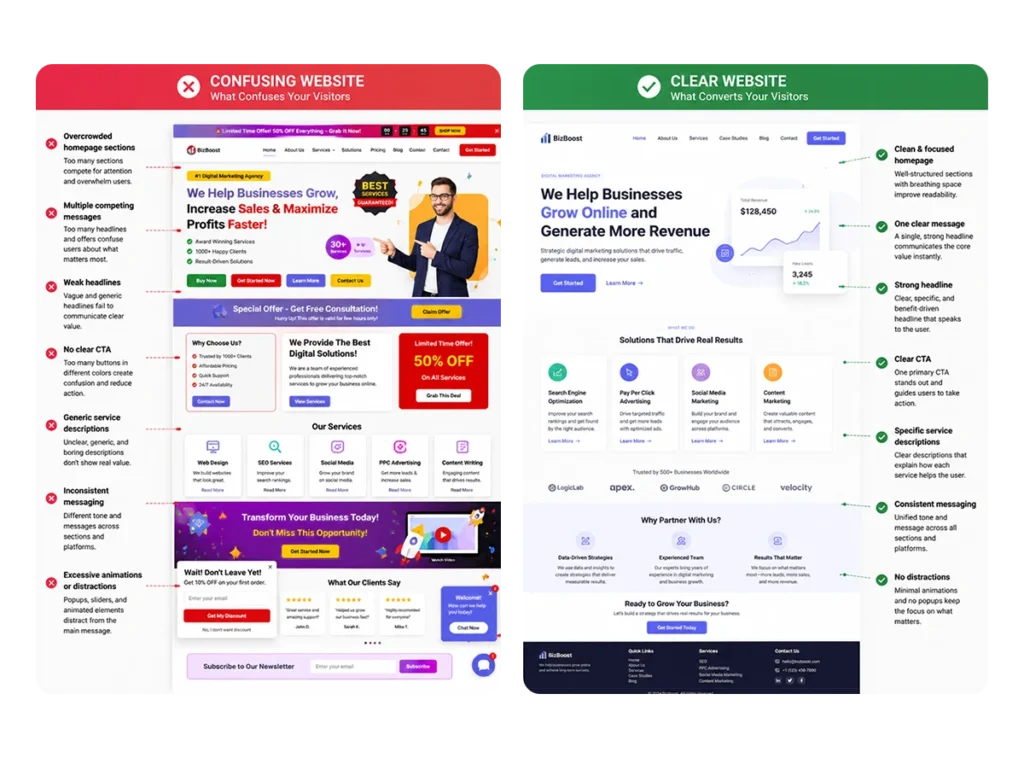
When messaging lacks hierarchy and focus, users struggle to understand what matters most. Even visually attractive websites can fail if communication is unclear.
How to Fix Your Messaging Step-by-Step
Improving business clarity begins with simplifying communication rather than adding more information.
- The first step is identifying the primary customer problem the business solves. Once this is clear, messaging should be rewritten around outcomes instead of technical explanations.
- Next, businesses should simplify website headlines, service descriptions, and calls-to-action using plain language that users instantly understand.
- After that, messaging consistency should be maintained across websites, ads, and social media platforms so users receive the same core message everywhere.
- Finally, businesses should continuously test and refine messaging based on actual user behavior and engagement data.
Real-World Example of Confusing vs Clear Positioning
A common example of confusing positioning is a business that describes itself using broad terms like:
“Full-service digital innovation agency delivering scalable transformation solutions.”
While this sounds sophisticated, most users do not immediately understand what services are being offered.
A clearer version would be:
“We help businesses get more leads through websites, SEO, and advertising.”
The second message is more effective because it is specific, outcome-driven, and easy to understand instantly. In most cases, businesses improve conversions not by changing their services, but by improving how clearly those services are communicated.
Conclusion: Clarity Creates Conversions
One of the most valuable assets in digital marketing is not complexity, it is clarity. Businesses often assume that sounding more advanced makes them appear more professional, when in reality, simplicity creates stronger trust and faster understanding.
Customers do not convert because businesses explain everything. They convert because they quickly understand how the business solves their problem.
When messaging is clear, users engage more confidently, websites convert more effectively, and marketing becomes significantly more efficient. The goal is not to impress users with complexity, it is to make decision-making easier.
In modern digital marketing, clarity is not just “Communication” It is a “Conversion Strategy”.