Can More Google Reviews Help Your Business Rank Higher?
Short answer: yes, but only in a specific way, and not in the way most business owners assume.
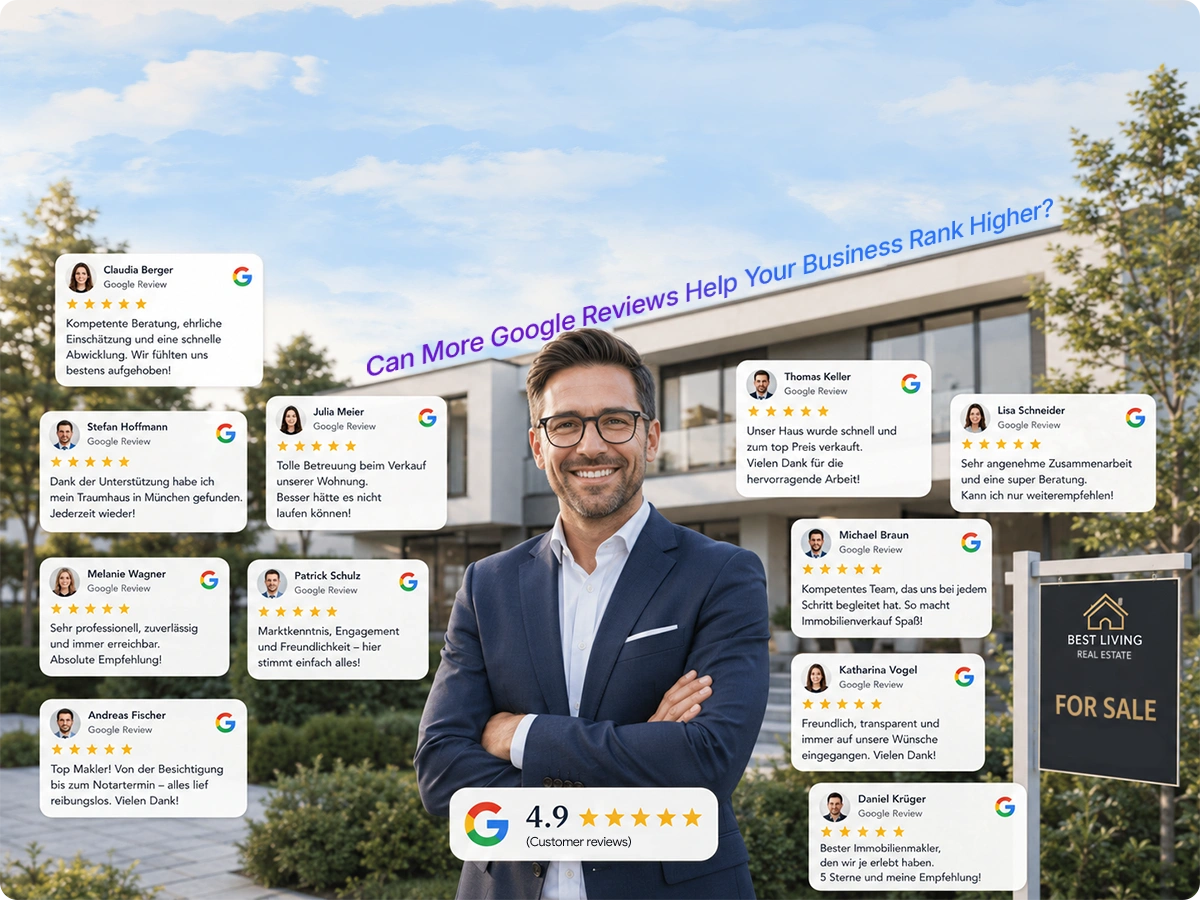
Google reviews don’t directly push your website up the organic rankings. What they do is feed into one of the three core factors Google uses to rank businesses in the local pack and on Google Maps: prominence. Google itself confirms that prominence is partly based on how many reviews a business has, and that more reviews along with positive ratings can help local ranking. The more reviews you have, the better your rating, and the more recent your review activity, the stronger that prominence signal becomes and the more likely you are to outrank a competitor with a thinner review profile.
This guide breaks down exactly how reviews affect your ranking, what doesn’t actually move the needle (despite what you may have heard), and how to build a review strategy that compounds over time instead of fizzling out after a one-time push.
Table of Contents
The Short Answer: Yes, Through “Prominence”
Google’s local search algorithm ranks businesses in the map pack and on Maps using three primary factors: relevance, distance, and prominence.
Reviews feed directly into the third factor: prominence. In Google’s own words, more reviews and positive ratings can improve your business’s local ranking. That makes reviews one of the few ranking levers you can actually control you can’t move your business closer to every searcher, and relevance is mostly fixed by your category and services, but your review profile is something you build every week.
How Google Actually Uses Reviews to Rank You
Reviews aren’t a single signal they’re a cluster of related signals that Google evaluates together:
- Volume : the total number of reviews your business has accumulated
- Rating : your overall average star rating
- Recency : how recently you’ve received reviews (a profile with 10 reviews from the past month often outperforms one with 200 reviews from three years ago)
- Velocity : how steadily new reviews come in over time, rather than in one-off bursts
- Response activity : whether you’re replying to reviews, which signals an actively managed business
None of these work in isolation. A business with a high rating but no recent activity looks stale. A business with high review volume but a mediocre rating doesn’t inspire confidence. Google and the people reading your profile are weighing all of these together.
Reviews and the Local Pack vs. Organic Website Rankings
It’s worth being precise here, because this is where a lot of confusion comes from.
| Local Pack / Google Maps | Organic Website Rankings | |
| Direct review impact | Yes, confirmed ranking factor (prominence) | No, not a direct ranking factor |
| Indirect impact | N/A (it’s already direct) | Yes, through click-through rate, trust, and conversion behavior |
| What helps | Volume, rating, recency, responses | Reviews displayed on-site with schema markup can earn star-rating rich snippets, improving CTR |
In other words: reviews have a direct, confirmed effect on whether you show up in the map pack and Google Maps results. For your website’s organic rankings, the effect is indirect reviews build trust and improve click-through rates, which can support rankings over time, but they aren’t a direct ranking input the way they are for local pack placement.
If you want reviews to support your broader SEO strategy beyond just your Business Profile, displaying them on your website with proper review schema markup is the way to extend their value into organic search.
What Actually Matters: Volume, Rating, and Recency
Volume. More reviews generally signal more real-world activity and credibility. There’s no fixed number that guarantees ranking success, it depends on what your top competitors have. If the businesses outranking you have 80+ reviews and you have 15, that gap is one of the clearest places to focus.
Rating. Google tends to favor businesses with a rating above 4.0. Ratings below 3.5 can actively suppress visibility. Interestingly, a “perfect” 5.0 rating with very few reviews can look less trustworthy than a 4.6-4.8 average backed by hundreds of reviews both to customers and, by extension, to the trust signals Google is weighing.
Recency. Fresh reviews tell Google (and customers) that your business is currently active, not just historically established. A steady trickle of new reviews even just one or two a week outperforms a single bulk push followed by months of silence.
Does Responding to Reviews Affect Ranking?
Yes, indirectly and it’s one of the most commonly skipped opportunities. Responding to reviews does two things at once:
- It creates fresh, indexed content on your profile. Every response is new text Google can read and factor into relevance and activity signals.
- It signals active management. A profile where the owner replies to both praise and complaints looks engaged. A profile full of unanswered reviews especially unanswered negative ones looks neglected.
This won’t cause an overnight ranking jump on its own, but as part of a consistent strategy, it reinforces the same prominence signals reviews already feed into.
What Doesn’t Work (Despite the Myths)
A few common claims about reviews and SEO don’t hold up under closer scrutiny:
- “Asking customers to mention keywords in their reviews boosts rankings.” Controlled testing has found that keywords appearing in customer review text have no measurable impact on rankings. What does appear to help is using natural, relevant keywords in your own responses to reviews, since Google indexes that response text.
- “Any negative review will hurt your ranking.” A handful of negative reviews within a large, mostly positive base has minimal ranking impact. Google’s systems are built to reflect a realistic range of customer experiences a perfect, unblemished record can actually look suspicious rather than trustworthy.
- “Buying or incentivizing reviews is a shortcut.” Google’s fake review detection has improved significantly, and the penalties for manipulated reviews are real, including suspension. A slower, authentic review stream consistently outperforms a fake one in the long run.
How Many Reviews Do You Actually Need?
There’s no universal number it depends entirely on your market and competition. As a rough guide:
- In low-competition local categories, 20–30 solid, recent reviews can be enough to compete effectively.
- In competitive categories (restaurants, dentists, law firms, home services), 50–100+ recent reviews is often where businesses start to hold a strong position.
The more useful exercise is comparing yourself directly to the businesses currently outranking you in your target search. If they’re ahead of you on rating, volume, and recency, closing that specific gap not chasing an arbitrary number is where your effort should go.
What About Negative Reviews?
Negative reviews are not automatically damaging, and trying to suppress or fight them (through legal threats or false claims) is both against Google’s policies and counterproductive. What actually matters is:
- How you respond. A thoughtful, professional response to a negative review often does more for trust than the negative review does damage.
- Your overall rating trend. A small number of negative reviews within a much larger positive base barely moves your average. The danger zone is when your overall rating drifts below roughly 3.5-4.0, where it starts to filter you out of consideration for a meaningful share of searchers.
If your business is regularly accumulating new positive reviews, the occasional negative one is a normal part of an authentic review profile not a problem to panic over.
Building a Review Strategy That Actually Works
The businesses that win on reviews don’t treat them as a one-time task. A few practical habits make the biggest difference:
- Ask consistently, not occasionally. A short text or email follow-up shortly after a positive service interaction is the highest-converting way to request a review.
- Make it effortless. Provide a direct link to your review page friction is the biggest reason satisfied customers never leave a review.
- Respond to everything. Positive or negative, a response shows engagement and reinforces the activity signals tied to prominence.
- Track your pace, not just your total. Aim for steady weekly or monthly review velocity rather than sporadic bursts.
- Pair reviews with the rest of your profile. Reviews work best as part of a complete, accurate, and consistently maintained Google Business Profile not as a standalone fix layered onto a neglected listing.
If your business has struggled to show up at all on Maps regardless of your review count, the issue may sit elsewhere in your profile setup our guide on why your business isn’t showing on Google Maps walks through the other common causes.
Want Help Building a Review Strategy That Moves Your Ranking?
Reviews are one of the few local ranking factors a business can directly influence but building real momentum takes a consistent process, not a one-time request campaign. Our team can help you set up a sustainable review system alongside the rest of your Google Business Profile and local SEO strategy.
Book a Strategy Session and we’ll show you exactly where your review profile stands against your local competitors.
FAQs: Google Reviews and Ranking
Do Google reviews directly affect my website’s SEO?
Not directly. Reviews are a confirmed ranking factor for the local pack and Google Maps through “prominence,” but for your website’s organic rankings, the effect is indirect primarily through improved click-through rates and trust when reviews are displayed with schema markup.
How quickly can new reviews impact my ranking?
Google recrawls Business Profiles regularly, so new reviews can influence prominence signals within days. The fuller effect tends to compound over weeks and months as recency and review velocity accumulate.
Can I lose ranking from negative reviews?
A few negative reviews within a larger positive base typically have minimal impact. The bigger risk is an overall rating that drifts below roughly 3.5–4.0, which can suppress visibility regardless of review volume.
Does asking customers to mention specific keywords help?
No, controlled testing has shown that keywords within customer review text don’t move rankings. Using natural, relevant language in your own responses to reviews is the version of this that actually contributes to relevance signals.
Is it better to have 5.0 stars with 10 reviews or 4.7 stars with 200 reviews?
Generally, the latter. A high volume of reviews with a strong (not necessarily perfect) rating tends to read as more trustworthy and established than a small number of perfect reviews, both to customers and in terms of overall prominence signals.
Do Google Business Profile posts help with ranking the same way reviews do?
No. Posts can support engagement and click-through rates, but controlled studies tracking hundreds of keywords have found no direct ranking movement tied to posting activity, unlike the confirmed, direct relationship between review signals and prominence.
Want a clear read on how your review profile compares to your local competitors? Contact Luniea today and we’ll walk through it with you.