Why Most Agencies Don’t Connect Your Systems (And Why It Matters)
Introduction
You hired a marketing agency to grow your business. They’re running ads, creating content, and posting on social media. But something feels off.
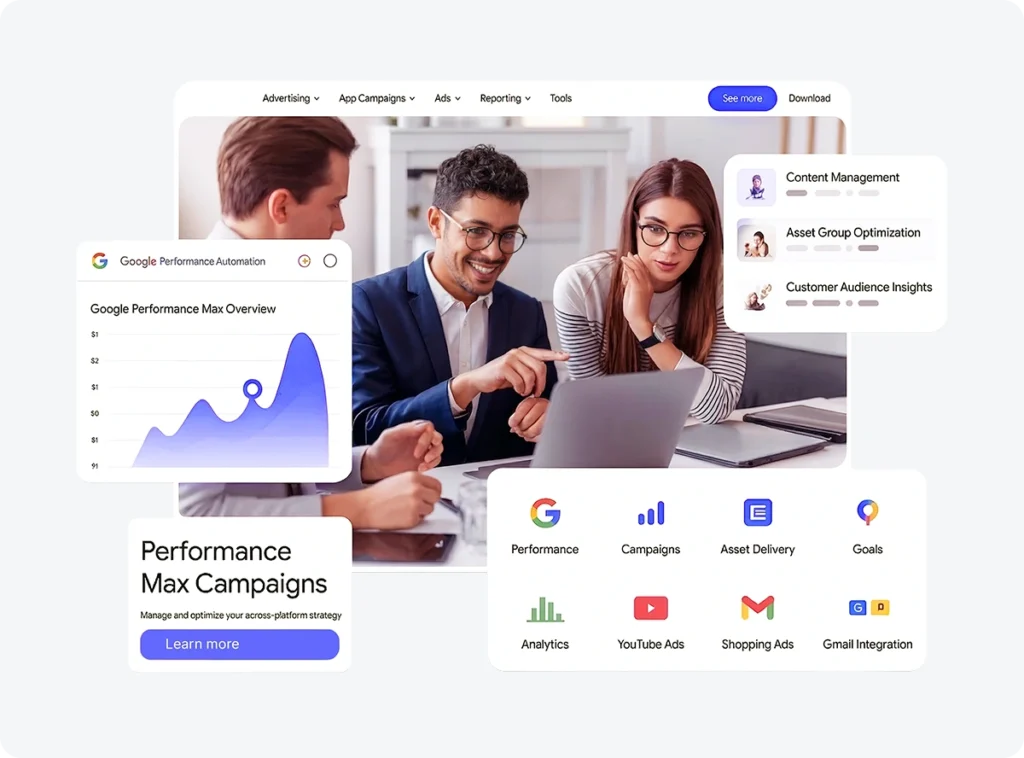
Your ad data doesn’t match your analytics. Your CRM doesn’t talk to your email platform. Your sales team can’t see which campaigns generated leads. You’re using 10+ disconnected tools, manually copying data between spreadsheets, and making decisions based on incomplete information.
The problem isn’t your agency’s creativity or effort. The problem is that most agencies don’t connect your systems.
In today’s data-driven business environment, disconnected systems create blind spots that cost you money, time, and growth opportunities. According to recent research, companies using disconnected tools waste 30% of their marketing budget on efforts they can’t properly track or optimize.
At Luniea, we take a different approach. We believe your marketing technology should work together seamlessly, giving you a complete picture of your customer journey and ROI. In this post, we’ll expose why most agencies fail at system integration, the real cost of disconnected tools, and how to find an agency that actually connects your systems for measurable growth.
Table of Contents
What Does “Connecting Your Systems” Mean?
Before we dive into the problem, let’s clarify what system integration actually means for your business.
Connected Systems Defined
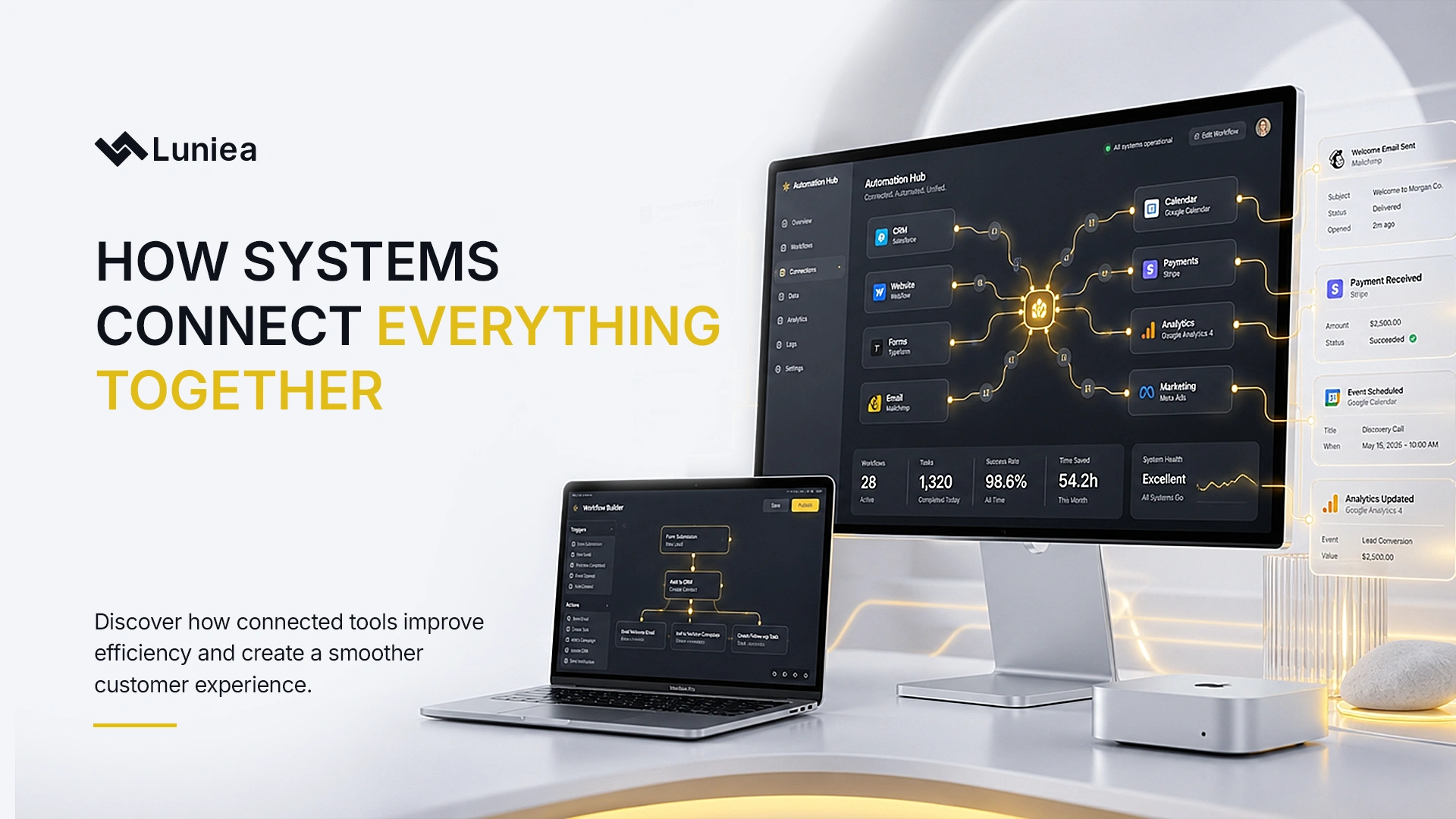
Connecting your systems means integrating your marketing, sales, and business tools so they share data automatically. This creates a unified ecosystem where information flows seamlessly between platforms.
Common Tools That Should Be Connected
| Tool Category | Examples | Should Connect To |
|---|---|---|
| Advertising Platforms | Google Ads, Facebook Ads, LinkedIn Ads | Analytics, CRM, Email |
| Analytics | Google Analytics 4, Adobe Analytics | CRM, Ads, Email |
| CRM | HubSpot, Salesforce, Pipedrive | Email, Ads, Support |
| Email Marketing | Mailchimp, Klaviyo, ActiveCampaign | CRM, Website, Ads |
| Website/CMS | WordPress, Webflow, Shopify | Analytics, CRM, Forms |
| Communication | Slack, Microsoft Teams | CRM, Project Management |
| Project Management | Asana, Monday, ClickUp | CRM, Email, Slack |
| Support/Helpdesk | Zendesk, Intercom | CRM, Email |
What Connected Systems Look Like in Practice
Disconnected (Common Scenario):
- Customer clicks Facebook ad → lands on website → fills contact form
- Form submission goes to email inbox
- Sales team manually enters lead into CRM
- Marketing team manually tracks ad spend in spreadsheet
- No automatic attribution showing which ad generated the sale
- Data lives in 5 different platforms
Connected (Integrated Scenario):
- Customer clicks Facebook ad → lands on website → fills contact form
- Form submission automatically creates lead in CRM
- Ad platform automatically imports conversion data
- Email platform automatically adds lead to nurture sequence
- Dashboard shows complete customer journey from ad click to sale
- All data syncs automatically across platforms
The Hidden Problem: Most Agencies Work in Silos
Here’s the uncomfortable truth: most marketing agencies focus on their channel, not your entire business ecosystem.
The Specialization Trap
Agencies often specialize in one area:
- SEO agency optimizes your website
- Social media agency posts on Instagram
- PPC agency manages Google Ads
- Email agency sends newsletters
Each agency does their job well. But none of them connect the dots between channels. Each operates in isolation, creating data silos that prevent you from seeing the full picture.
Why This Happens
| Reason | Explanation |
|---|---|
| Lack of expertise | Many marketers aren’t trained in technical integrations |
| Comfort zone | Agencies stick to what they know (ads, content, social) |
| No incentive | Clients don’t ask for integration, so agencies don’t offer it |
| Tool complexity | Integrations require technical knowledge of APIs, webhooks, Zapier |
| Billing model | Most agencies charge per campaign, not per business outcome |
| Short-term thinking | Focus on immediate results, not long-term infrastructure |
The Typical Agency Pitch (That Misses the Point)
“We’ll increase your website traffic by 200%!”
“We’ll generate 500 new leads per month!”
“We’ll boost your social media engagement by 500%!”
These sound impressive until you realize:
- You can’t track if those leads actually become customers
- You don’t know which channels drive the most revenue
- Your sales team is overwhelmed with unqualified leads
- You’re spending more on marketing but not growing revenue
Traffic and leads don’t matter if they don’t connect to revenue.
5 Reasons Why Agencies Don’t Connect Your Systems
1. They Lack Technical Integration Skills
Most marketing professionals come from creative or strategic backgrounds, not technical ones. They understand:
✅ How to write compelling ad copy
✅ How to design engaging social media posts
✅ How to optimize keywords for SEO
But they often don’t know:
❌ How to set up API connections
❌ How to configure webhooks
❌ How to build custom dashboards in Looker Studio
❌ How to use tools like Zapier, Make, or Workato
Result: They avoid integrations entirely because it’s outside their expertise.
2. It’s Not Part of Their Standard Service Package
Most agencies offer preset service packages:
- Starter: $2,000/month (SEO + content)
- Growth: $5,000/month (SEO + content + social)
- Enterprise: $10,000/month (everything)
System integration is rarely included because:
- It requires additional technical resources
- It’s harder to price and scope
- Most clients don’t request it
- It’s not “sexy” enough to sell as a feature
Result: Integration becomes an expensive add-on that few clients purchase.
3. They’re Focused on Short-Term Campaign Wins
Agencies are judged on monthly performance metrics:
- Did ad spend generate clicks this month?
- Did social posts get engagement?
- Did blog posts rank on Google?
System integration doesn’t show immediate results. It takes weeks to set up properly, and the benefits compound over months.
Result: Agencies prioritize quick wins that demonstrate immediate value over infrastructure that creates long-term value.
4. They Don’t Understand Your Full Business Stack
Many agencies never ask:
- What CRM do you use?
- How does your sales process work?
- What tools does your team use daily?
- Where does data currently live?
They jump straight into executing campaigns without understanding your existing technology ecosystem.
Result: They build campaigns that don’t integrate with your actual business operations, creating more disconnected tools.
5. Agency Business Models Discourage Integration
Here’s the conflict most agencies won’t admit:
| Agency Model | Incentive |
|---|---|
| Per-campaign billing | Run more campaigns, not fewer |
| Per-channel billing | Manage more tools, not consolidate them |
| Hourly billing | Spend more hours, not automate |
If an agency connects your systems and automates processes, they might actually reduce their own billable hours.
Result: There’s a hidden financial incentive to keep systems disconnected and manual work ongoing.
The Cost of Disconnected Systems
Let’s talk about what disconnected systems actually cost your business in money, time, and missed opportunities.
Direct Financial Costs
| Cost | Impact |
|---|---|
| Wasted ad spend | 30% of budget on untracked, unoptimized campaigns |
| Manual data entry | 10–20 hours/week × $50/hour = $2,000–$4,000/month |
| Duplicate tools | Paying for 2 CRMs or 2 analytics tools unnecessarily |
| Misled decisions | Making strategy changes based on incomplete data |
| Failed campaigns | Running campaigns that don’t convert because of tracking gaps |
Time Costs
Typical weekly time waste from disconnected systems:
| Task | Time Spent | Monthly Cost |
|---|---|---|
| Manual data entry between tools | 5–10 hours | $1,000–$2,000 |
| Creating reports from multiple sources | 3–5 hours | $600–$1,000 |
| Troubleshooting data mismatches | 2–4 hours | $400–$800 |
| Training new team members on disconnected tools | 2–3 hours | $400–$600 |
| Total | 12–22 hours/week | $2,400–$4,400/month |
Hidden Business Costs
- Slower decision-making: You can’t make fast decisions without real-time, unified data
- Poor customer experience: Customers get repetitive emails or irrelevant offers because systems don’t share data
- Inability to scale: Manual processes break down as you grow
- Low team morale: Your team spends time on data entry instead of strategic work
- Lost revenue opportunities: You miss upsell chances because you don’t see the full customer picture
Real-World Impact: What Disconnection Looks Like
Let’s walk through a typical customer journey to see how disconnected systems create problems at every stage.
The Disconnected Customer Journey
Stage 1: Customer sees Facebook ad
❌ Ad data lives only in Facebook Ads Manager
Stage 2: Customer clicks to website
❌ Website analytics disconnected from ad platform
Stage 3: Customer fills contact form
❌ Form submission goes to email inbox only
Stage 4: Sales team calls customer
❌ No record in CRM of which ad generated lead
Stage 5: Customer becomes paying client
❌ Marketing never knows this campaign generated revenue
Stage 6: Marketing continues running same ad
❌ Ad spend is $5,000/month but ROI is unknown
The Same Journey with Connected Systems
Stage 1: Customer sees Facebook ad
✅ Ad platform tracks impression and click
Stage 2: Customer clicks to website
✅ GA4 tracks session and attribution
Stage 3: Customer fills contact form
✅ Form creates lead in CRM automatically
✅ Lead tagged with ad source and campaign
Stage 4: Sales team calls customer
✅ CRM shows full customer journey and ad source
✅ Sales knows which campaign to reference
Stage 5: Customer becomes paying client
✅ CRM marks deal as “won” with revenue amount
✅ Revenue automatically imported back to Facebook Ads
Stage 6: Marketing sees full ROI
✅ Dashboard shows: $5,000 spent → $50,000 revenue
✅ Campaign optimized to scale winning ads
How Connected Systems Transform Business Growth
When your systems are properly connected, the benefits compound across your entire business.
1. Complete Customer Attribution
You finally know:
- Which ad generated each lead
- Which content path led to conversion
- Which channels drive the most revenue (not just clicks)
- Customer lifetime value by acquisition channel
Result: You can double down on what works and cut what doesn’t.
2. Real-Time Decision Making
Connected systems give you:
- Live dashboards showing campaign performance
- Automatic alerts when metrics change
- Real-time data for team meetings
- Ability to pivot quickly based on results
Result: You make faster, data-driven decisions instead of guessing.
3. Automated Workflows
Time-saving automation examples:
- Lead enters CRM → automatically added to email nurture sequence
- Deal marked “won” → automatically triggers onboarding email
- Customer purchases → automatically added to VIP segment
- Support ticket created → automatically notifies Slack channel
Result: Your team saves 10+ hours/week on manual tasks.
4. Unified Reporting
Instead of 10 different reports, you have:
- One dashboard showing all marketing metrics
- Cross-channel attribution (not just last-click)
- Revenue attribution connected to ad spend
- Automated reports sent to stakeholders weekly
Result: You understand your true ROI and can justify marketing spend to leadership.
5. Better Customer Experience
Connected systems enable:
- Personalized messaging based on customer behavior
- No repetitive emails (systems know what they’ve received)
- Relevant offers based on purchase history
- Seamless handoffs between marketing and sales
Result: Higher conversion rates and customer satisfaction.
6. Scalable Infrastructure
As you grow, connected systems:
- Handle increased volume without extra manual work
- Integrate new tools without breaking existing workflows
- Provide data needed to make expansion decisions
- Support team growth with automated onboarding
Result: You can scale marketing without proportional increases in headcount.
What to Look for in an Agency That Integrates Systems
Not all agencies are created equal. Here’s how to identify an agency that actually connects your systems:
✅ Green Flags (What You Want)
| Question to Ask | Good Answer |
|---|---|
| “Do you integrate our CRM with our ad platforms?” | “Yes, we set up automatic conversion tracking and lead sync between HubSpot/Salesforce and Google Ads, Facebook Ads, LinkedIn Ads” |
| “How do you track ROI?” | “We build custom dashboards in Looker Studio that connect GA4, CRM, and ad platforms to show revenue attribution” |
| “What tools will we need?” | “We’ll audit your current stack and recommend only what’s necessary, then integrate everything to work together” |
| “What happens after we hire you?” | “First, we do a technical audit, then set up integrations, then launch campaigns with proper tracking” |
| “Can you show us examples?” | “Here are 3 dashboards we built for similar clients showing full attribution” |
❌ Red Flags (What to Avoid)
| Question to Ask | Reassuring-But-Empty Answer |
|---|---|
| “Do you integrate systems?” | “We focus on creative and strategy that’s where the ROI is” [Translation: We don’t do integration] |
| “How do you track conversions?” | “We use Facebook Pixel and Google Analytics” [Translation: Last-click only, no CRM integration] |
| “What’s our tech stack?” | “Just give us access to Google Ads and we’ll handle the rest” [Translation: No integration planning] |
| “Can you show us ROI?” | “We generated 500 leads last month” [Translation: No revenue attribution] |
Essential Questions to Ask Before Hiring
- What is your process for setting up tracking and integration?
- Which tools do you integrate with, and how do you connect them?
- Do you build custom dashboards? What does that include?
- How do you attribute revenue to specific campaigns?
- What happens to our data if we leave your agency?
- Do you have technical staff who handle integrations, or just marketers?
- Can you show us a dashboard you built for a similar client?
Common Questions About System Integration
How long does it take to connect systems?
Typical timeline:
- Simple integration (2–3 tools): 1–2 weeks
- Medium integration (5–7 tools): 3–4 weeks
- Complex integration (10+ tools): 6–8 weeks
Rushing integrations causes problems. Proper setup takes time but pays off long-term.
How much does system integration cost?
| Integration Level | Typical Cost |
|---|---|
| Basic (Zapier + 3–5 tools) | $1,000–$3,000 setup |
| Intermediate (Custom dashboards + CRM) | $3,000–$8,000 setup |
| Advanced (Full stack + API custom work) | $8,000–$20,000+ setup |
Monthly costs: $50–$500/month for tools like Zapier, Make, or custom hosting
ROI: Most businesses see 3–5x ROI within 6 months through saved time and better ad performance.
Do we need a separate integration specialist?
Not necessarily. Look for an agency that includes integration in their marketing services. You want:
- A marketing agency that understands technical implementation
- NOT a separate integration consultant who doesn’t understand marketing
Best approach: One agency that handles both strategy AND technical execution. Luniea
What if we’re already working with an agency that doesn’t integrate?
Options:
- Request integration as an add-on service (they may partner with a technical team)
- Hire a separate integration specialist (but now you have two vendors to manage)
- Switch to an agency that includes integration (recommended for long-term growth)
Which tools are best for connecting systems?
| Purpose | Recommended Tools |
|---|---|
| Automation | Zapier, Make (formerly Integromat), Workato |
| Dashboards | Looker Studio, Tableau, Microsoft Power BI |
| CRM | HubSpot (best for marketing integration), Salesforce (enterprise) |
| Analytics | Google Analytics 4, Adobe Analytics |
| ActiveCampaign, Klaviyo (e-commerce), HubSpot | |
| Advertising | Google Ads, Facebook Ads Manager, LinkedIn Campaign Manager |
Next Steps
You now know why most agencies don’t connect your systems, the hidden costs of disconnected tools, and what to look for in an agency that does integration right.
Your 5-Step Action Plan
Step 1: Audit Your Current Stack
- List all your marketing/sales tools
- Identify which tools don’t talk to each other
- Note time spent on manual data entry
Step 2: Identify Integration Gaps
- Can you attribute revenue to specific campaigns?
- Does your CRM automatically receive lead data?
- Do you have one dashboard or 10 different reports?
- Can you see the full customer journey?
Step 3: Talk to Your Current Agency
- Ask if they offer system integration
- Request a integration audit
- Set expectations for connected campaigns
Step 4: Evaluate New Agency Options
- Use the questions from this guide
- Ask for dashboard examples
- Check if integration is included in their service
Step 5: Plan Your Integration
- Prioritize critical integrations first (CRM + Ads + Analytics)
- Set realistic timeline (4–6 weeks minimum)
- Budget for setup costs and ongoing maintenance
Ready to Work with an Agency That Actually Connects Your Systems?
At Luniea, we don’t just run campaigns, we build integrated marketing ecosystems that drive measurable growth.
Our approach includes:
✅ Technical audit of your current tool stack
✅ Custom integrations connecting ads, analytics, CRM, and email
✅ Live dashboards showing complete attribution and ROI
✅ Automated workflows that save your team 10+ hours/week
✅ Revenue-focused strategy that connects marketing to business outcomes
✅ Ongoing optimization based on real data, not guesses
Unlike traditional agencies, we measure success by your revenue growth, not just clicks, leads, or vanity metrics.
Key Takeaways
| Point | Why It Matters |
|---|---|
| Most agencies work in silos | They focus on their channel, not your entire business ecosystem |
| Disconnected systems cost 30% of marketing budget | Wasted spend on untracked, unoptimized campaigns |
| Manual work wastes 12–22 hours/week | Your team should be doing strategy, not data entry |
| Integration takes 3–6 weeks | But creates long-term compounding value |
| Look for agencies that build dashboards | If they can’t show you a unified dashboard, they’re not integrating |
| Revenue attribution is non-negotiable | You need to know which campaigns generate actual revenue |
| Connected systems enable scaling | You can grow without proportional headcount increases |
Don’t let disconnected systems hold your business back. The agencies that will win in 2026 are the ones that integrate technology, data, and strategy, not just create pretty ads or write blog posts.
Contact Luniea today for a free technical audit and see how connected systems can transform your marketing ROI.