The Biggest Mistake Small Businesses Make Online

A practical breakdown of the most common reason small businesses struggle to grow online not because of lack of effort or tools, but because of missing structure. This guide explains how “random marketing” silently drains budgets, reduces consistency, and prevents businesses from building a predictable digital growth system.
Table of Contents
Introduction: Why Most Businesses Struggle Online
Most small businesses enter the digital space with high expectations but inconsistent outcomes. They invest in social media, run occasional ads, build a website, and experiment with different marketing ideas, yet still fail to generate stable leads or predictable revenue. The problem is rarely lack of effort. In most cases, businesses are actively doing marketing, but without a structured system that connects all their efforts together.
This leads to a common frustration: “We are doing everything, but nothing is working consistently.” The reality is that digital success is not based on isolated actions but on how well those actions are connected into a unified strategy. Without that connection, even good marketing efforts lose their effectiveness.
Understanding this gap is the first step toward fixing long-term performance issues in SEO, paid ads, and overall digital presence.
The Biggest Mistake: Lack of Strategy
The most critical mistake small businesses make online is not technical, financial, or even creative it is the lack of a clear digital strategy. A strategy defines how all marketing efforts work together toward a single business goal. Without it, businesses end up reacting to trends, copying competitors, and switching tactics frequently without understanding why results are inconsistent.
When strategy is missing, decisions are often made based on urgency rather than direction. This leads to fragmented marketing efforts where nothing builds upon the other. Ads run without supporting landing pages, content is created without targeting intent, and websites exist without conversion structure.
A lack of strategy does not mean lack of activity. It means lack of alignment, which is far more damaging in the long run.
What “Random Marketing” Looks Like
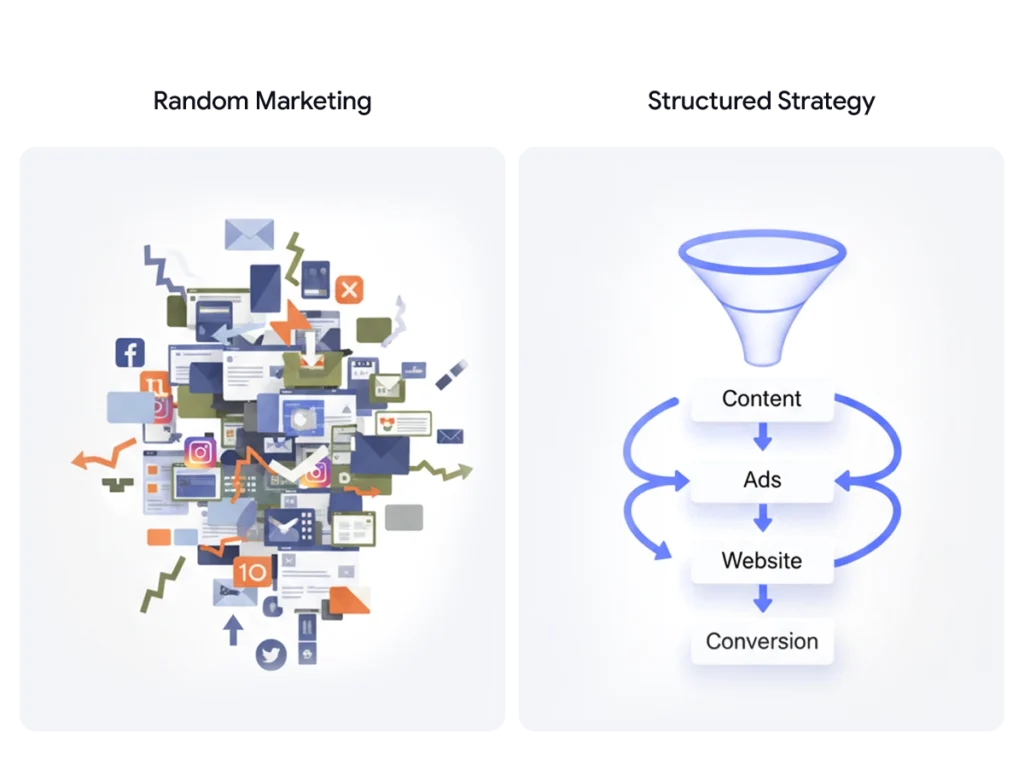
Random marketing is when businesses take individual marketing actions without a connected system behind them. It often looks productive on the surface because multiple activities are happening simultaneously, but none of them are designed to work together.
Posting without direction
One of the most common examples is posting content on social media without a clear objective. Businesses publish images, reels, or updates without understanding how those posts contribute to traffic, engagement, or conversions. As a result, content generates attention but not business outcomes.
Running ads without funnel
Another common issue is running paid advertising campaigns without a proper funnel or landing page structure. Businesses invest in clicks but fail to guide users toward a structured conversion path. This leads to wasted ad spend and low return on investment, even when traffic levels appear strong.
Why This Mistake Costs You Money
The financial impact of a broken strategy is often underestimated. Businesses may believe they are saving money by avoiding strategic planning, but in reality, they lose significantly more through inefficient marketing spend and missed opportunities.
When marketing is unstructured, every channel operates in isolation. This creates duplication of effort, inconsistent messaging, and poor conversion rates. Even high-performing campaigns cannot compensate for a broken system because users are not guided through a structured journey.
Over time, this leads to increased cost per lead, lower ROI, and unpredictable business growth.
What a Structured Digital Strategy Looks Like
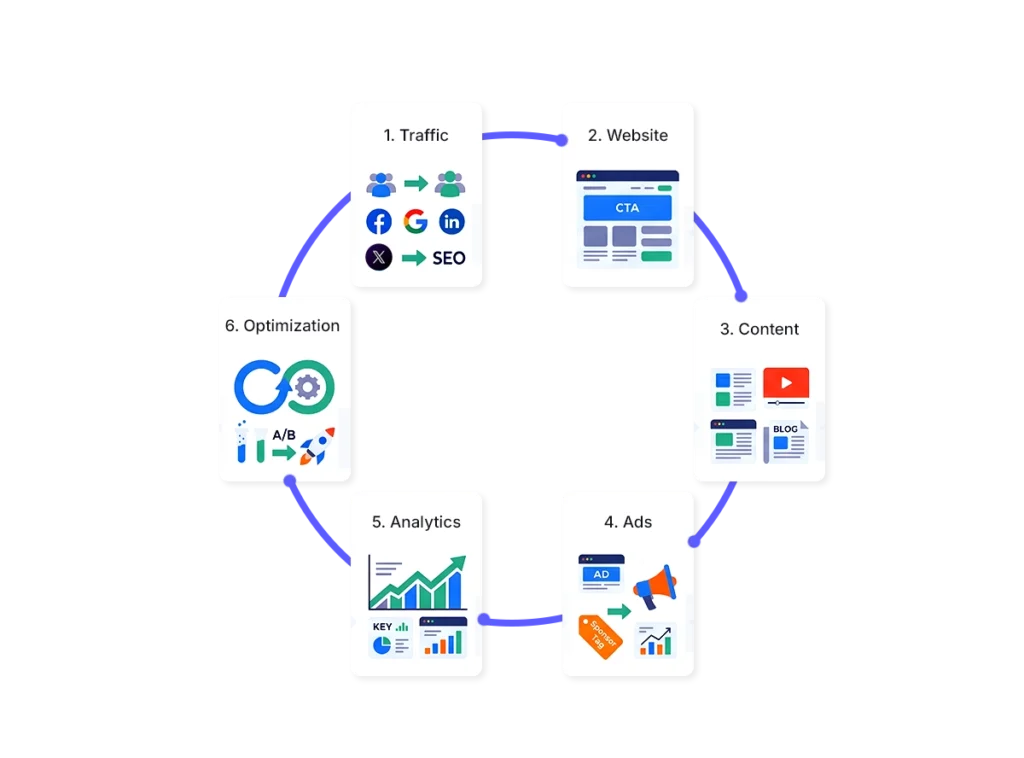
A structured digital strategy connects all marketing components into a unified system where each part supports the others. Instead of isolated actions, every activity is designed with a specific role in the customer journey.
In this system, content drives awareness, ads generate targeted traffic, the website converts visitors, and analytics measure performance to guide improvements. Each component feeds into the next, creating a continuous loop of optimization and growth.
The key difference is intentionality. Every action is planned with a clear purpose rather than executed randomly.
Key Components of a Winning Online Presence
A strong digital strategy is built on four essential pillars that must work together to create a stable growth system.
1. Website
The website acts as the central conversion hub. It is where all traffic ultimately arrives, and its role is to convert visitors into leads or customers. A strong website is structured, clear, and designed with conversion intent rather than just visual appeal.
2. Content
Content is responsible for building awareness and authority. It helps attract users through search engines and social platforms while educating them about the business. In a structured strategy, content is aligned with user intent and supports the overall funnel rather than existing independently.
3. Ads
Advertising brings targeted traffic into the system. Whether through Google Ads or social media platforms, ads must be aligned with landing pages and messaging to ensure consistency and improve conversion rates. Without alignment, traffic becomes expensive and inefficient.
4. Analytics
Analytics is the foundation of optimization. It helps businesses understand user behavior, track performance, and identify gaps in the system. Without data, improvement becomes guesswork, and scaling becomes unreliable.
How to Fix This Mistake Step-by-Step
Fixing a broken marketing system begins with clarity. The first step is to define a clear business objective and identify the primary conversion goal, whether it is leads, sales, or bookings. Once this is established, all marketing efforts must be evaluated against this goal.
The next step is to audit existing channels, including website structure, ad campaigns, and content strategy, to identify gaps in alignment. After identifying these gaps, businesses should restructure their website to improve conversion flow and adjust messaging across all platforms for consistency.
Finally, a tracking system must be implemented to measure performance accurately and guide continuous optimization. This transforms marketing from a reactive process into a controlled growth system.
Real-World Example of a Broken Strategy
In many real-world cases, businesses invest heavily in multiple marketing channels without seeing meaningful results. For example, a company may run Google Ads campaigns, post regularly on social media, and maintain a website, yet still struggle with lead generation.
The issue in such cases is not individual channel performance but lack of integration. Ads may attract traffic, but the landing page may not be optimized for conversion. Content may generate engagement, but it may not guide users toward a clear action. Without a unified strategy, each channel operates independently, resulting in weak overall performance.
Once these elements are aligned under a structured strategy, the same marketing efforts often produce significantly better results without increasing budget.
Conclusion: Strategy First, Tools Second
The biggest mistake small businesses make online is not choosing the wrong platform or running ineffective ads it is operating without a strategy. Tools like social media platforms, ad networks, and analytics systems are powerful, but only when they are guided by a clear and structured plan.
A strong digital presence is built on alignment, not activity. When strategy comes first, every marketing effort becomes more focused, efficient, and measurable. Without it, businesses remain stuck in cycles of inconsistent results regardless of how much effort they put in.
In digital growth, success is not about doing more it is about doing the right things in the right order, within a connected system designed for outcomes.