Retargeting Ads: Bring Back Visitors & Increase Sales
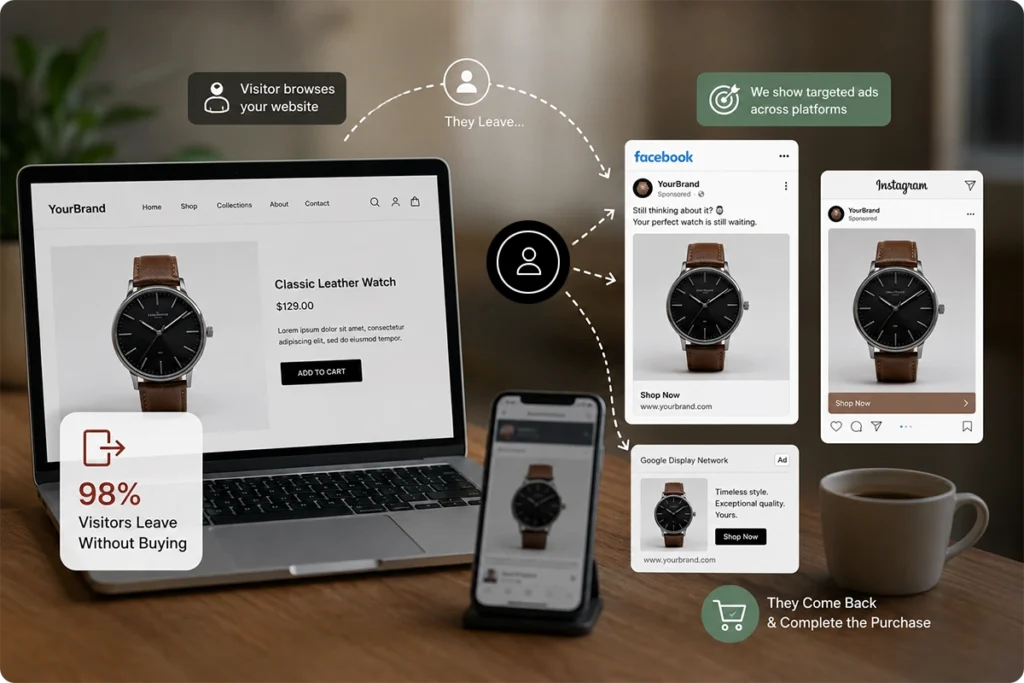
Someone visits your website, looks around, and leaves without calling, booking, or buying anything. On its own, that’s not a failure. It’s the normal outcome for the vast majority of first-time visitors to almost any business website. Salesforce Research found that during the first quarter of 2026, only 1.4 percent of visits to e-commerce websites worldwide converted into a purchase, which means the other 98.6 percent of visitors leave without buying. The question that actually matters is what happens next. Do you let that person disappear back into the internet, or do you have a way to remind them you exist right when they’re ready to act?
That’s what retargeting is built to do. Google itself describes the core value of this approach as showing ads to people who’ve previously interacted with your business right when they’re searching elsewhere and are more likely to make a purchase. This guide explains what retargeting actually is, how it technically works behind the scenes, where it shows up across Google, Facebook, and other platforms, and why it tends to be one of the more cost-effective tools available to a local or small business advertising online.
Table of Contents
What Retargeting Actually Means
Retargeting is a form of online advertising that shows ads specifically to people who have already visited your website or interacted with your business online, rather than to a cold, anonymous audience who has never heard of you. Instead of competing for attention from strangers, you’re staying visible to people who already showed real interest.
A simple way to picture it: someone visits your plumbing company’s website, looks at your emergency repair page, and leaves without calling. Over the next several days, that same person starts seeing your ad while reading the news, scrolling Instagram, or watching YouTube videos. That’s retargeting in action. You’re not trying to convince a stranger you’re worth considering. You’re reminding someone who already considered you that you’re still here.
Retargeting vs. Remarketing: Is There a Difference?
Functionally, no, though the terminology gets used inconsistently across the industry. According to Google’s own help documentation on remarketing, Google’s platform uses the term remarketing for this capability inside Google Ads, while other platforms and most of the broader marketing industry tend to use the word retargeting. They describe the same underlying strategy: showing ads to people based on their prior interaction with your business.
The one place this distinction occasionally creates confusion is that remarketing has also historically referred to re-engaging existing customers through email, while retargeting specifically refers to cookie-based or pixel-based ad serving to past visitors. In practice, when a business owner or marketer says either word today, they almost always mean the same thing: showing ads to people who already know you.
How Retargeting Actually Works
Behind the relatively simple idea is a fairly straightforward technical process.
Step 1: A visitor lands on your site. A small piece of code, often called a tag or pixel, sits on your website and notices when someone visits.
Step 2: That visitor gets added to an audience list. Depending on what you set up, this could be everyone who visited your site, people who looked at a specific service page, or people who started a form but didn’t finish it.
Step 3: That list becomes available for advertising. Once an audience reaches a minimum size, you can build ad campaigns specifically targeting that group rather than the general public.
Step 4: Your ads follow them across the platforms you’ve chosen. As that person continues browsing the web, watching YouTube, or scrolling social media, your ads appear, reminding them of what they were looking at.
There’s a practical detail worth knowing if you’re considering this for your own business. According to Google’s own documentation on remarketing list requirements, Google Ads requires a minimum audience size of 100 active visitors or users within the last 30 days before a list can actually be used for advertising, a threshold that applies across Search, Display, and YouTube. This is one reason newer or lower-traffic websites sometimes need to build general visibility and traffic first, often through SEO, before retargeting becomes a meaningfully sized tool in the marketing mix.
Where Retargeting Ads Show Up
Retargeting isn’t a single platform. It’s a strategy that gets applied across several of them, each with a slightly different flavor.
Google Display Network: Your ads can appear as banner or image ads across a huge number of partner websites and apps that past visitors browse after leaving your site.
YouTube: Past visitors can see your video or display ads while watching other YouTube content.
Search (RLSA): When a past visitor later searches on Google again, you can adjust your bids or show more targeted ad copy specifically because you know they’ve already interacted with your business.
Facebook and Instagram: Past visitors see your ads in their feed or stories as they continue scrolling those platforms.
Dynamic retargeting: Rather than a single generic ad, the specific product or service a visitor looked at gets shown back to them automatically, which tends to feel far more relevant than a generic message.
Why Retargeting Matters More Than Most Other Tactics
A few specific reasons retargeting earns a place in most well-run advertising accounts:
Most visitors don’t convert on their first visit. This is simply how online behavior works. People research, compare, get distracted, or aren’t quite ready yet. Without retargeting, every one of those visitors is essentially gone the moment they close the tab.
You’re advertising to warm interest, not cold attention. A stranger who has never heard of your business needs to be convinced you’re relevant before they’ll even consider clicking. Someone who already visited your site has done that work already. You’re simply reminding them, not introducing yourself from scratch.
It tends to be efficient relative to cold campaigns. Because you’re working with a smaller, more relevant audience instead of trying to reach the broadest possible group, retargeting campaigns often deliver a better cost per result than campaigns built around cold, unfamiliar audiences.
It keeps you visible during longer decision cycles. For businesses where customers don’t decide instantly, home renovation, legal services, healthcare, real estate, retargeting keeps your business in view through the entire research and comparison window instead of disappearing after a single visit.
Common Types of Retargeting Campaigns
A few practical setups cover the majority of what local and small businesses actually use:
General site visitor retargeting. The simplest setup: anyone who visited your site gets added to an audience and sees your ads afterward. A reasonable starting point, though less targeted than the options below.
Page-specific retargeting. Visitors to a specific service page, for example your emergency repair page, see ads specifically about that service, rather than a generic message about your business overall.
Cart or form abandonment retargeting. For businesses with online checkout or multi-step forms, this targets people who started but didn’t finish, often the highest-intent group available to retarget.
Customer list retargeting. Rather than targeting people based on website behavior, this uses an existing customer or contact list to either re-engage past customers or build a lookalike audience of similar people.
Search retargeting (RLSA). This shows different ad copy or adjusts bids specifically for people who’ve previously visited your site when they search again on Google, letting you treat a warm searcher differently from a cold one.
Setting Up Retargeting the Right Way
A few practical steps make the difference between a retargeting campaign that performs well and one that just burns budget:
- Install your tracking tag correctly across your entire site, not just on a few pages, so your audience data is complete from the start.
- Build specific audiences rather than one giant generic list. Segmenting by the page someone visited or the action they took lets you show far more relevant ad copy.
- Set a frequency cap. Showing the same ad to the same person dozens of times in a week tends to annoy rather than persuade. A reasonable cap keeps your brand visible without becoming irritating.
- Exclude people who already converted, so you’re not spending budget showing offers to people who already became customers.
- Use a defined time window. Shorter windows, often a couple of weeks, tend to capture genuine recent intent better than running the same audience for months after the original visit.
If your business runs paid search alongside retargeting, this is exactly the kind of ongoing setup and optimization our Paid Search Management services are built to handle, from initial audience setup through ongoing refinement.
Mistakes That Make Retargeting Annoying Instead of Effective
Showing the same ad endlessly with no frequency cap. This is the single most common complaint people have about retargeting, and it’s also one of the easiest problems to fix with a simple frequency setting.
Retargeting everyone the exact same way. Someone who briefly visited your homepage and someone who started booking an appointment are in very different places. Treating them identically wastes the advantage retargeting is supposed to offer.
Never refreshing the creative. Showing the exact same ad image and copy for months tends to lose effectiveness as people start to tune it out entirely.
Ignoring exclusions. Continuing to show offers to people who already purchased or already booked wastes budget and can come across as careless.
Running it with no underlying website traffic strategy. Retargeting only works on people who visited your site in the first place. If your traffic is thin, building it up through SEO or a broader paid strategy needs to happen alongside, not instead of, retargeting.
Is Retargeting Right for Every Business?
Mostly yes, but with one caveat worth being honest about. Retargeting works best when there’s a meaningful gap between when someone first shows interest and when they’re ready to act, which describes most considered purchases and most service-based businesses well.
It’s less useful for businesses with extremely short, immediate decision cycles, genuine emergency services being the clearest example, where the person calling right now has no real research-and-compare phase to be retargeted through. Even then, retargeting can still play a role in building broader brand familiarity, just not as a direct response tool in the same way it works for a more considered purchase.
Want Help Setting Up Retargeting That Actually Performs?
Retargeting sounds simple in concept, but getting the audience setup, frequency, and creative right is what separates a campaign that quietly converts from one that just follows people around without results. Our team can build this properly as part of a broader paid advertising strategy.
Book a Strategy Session and we’ll walk through whether retargeting makes sense for your business and how to set it up correctly.
FAQs: Retargeting Explained
Is retargeting the same as remarketing?
Functionally, yes. Google’s own platform uses “remarketing” as its official term within Google Ads, while “retargeting” is the more commonly used word across the broader industry and other ad platforms. Both describe showing ads to people based on prior interaction with your business.
How long should a retargeting campaign run for a single visitor?
This depends on your sales cycle, but shorter windows, often around two weeks, tend to outperform much longer ones, since they focus on capturing genuine recent intent rather than chasing interest that’s already faded.
Do I need a certain amount of website traffic before retargeting makes sense?
Yes, to some degree. Google Ads requires audience lists to reach a minimum of 100 active users within the last 30 days before they’re eligible to serve ads, so very low-traffic sites may need to build general visibility first, often through SEO or broader campaigns, before retargeting becomes a meaningful part of the strategy.
Why do retargeted ads sometimes feel like they’re following me everywhere?
This usually happens when a business hasn’t set a frequency cap, allowing the same ad to show repeatedly to the same person. A well-managed retargeting campaign limits how often any one person sees the same ad.
Does retargeting work for service businesses, not just online stores?
Yes. Any business where customers take time to decide, home services, healthcare, legal, real estate, professional services, benefits from staying visible to people who’ve already shown interest but haven’t yet converted.
Is retargeting more affordable than other types of advertising?
Often, yes, since you’re advertising to a smaller, more relevant, already-interested audience rather than competing for broad, cold attention. That said, actual cost depends heavily on your industry, audience size, and how well the campaign is set up.
Curious whether retargeting fits into your current advertising strategy? Contact Luniea today and we’ll take a look at your account together.