From Click to Client: The Full Funnel Explained
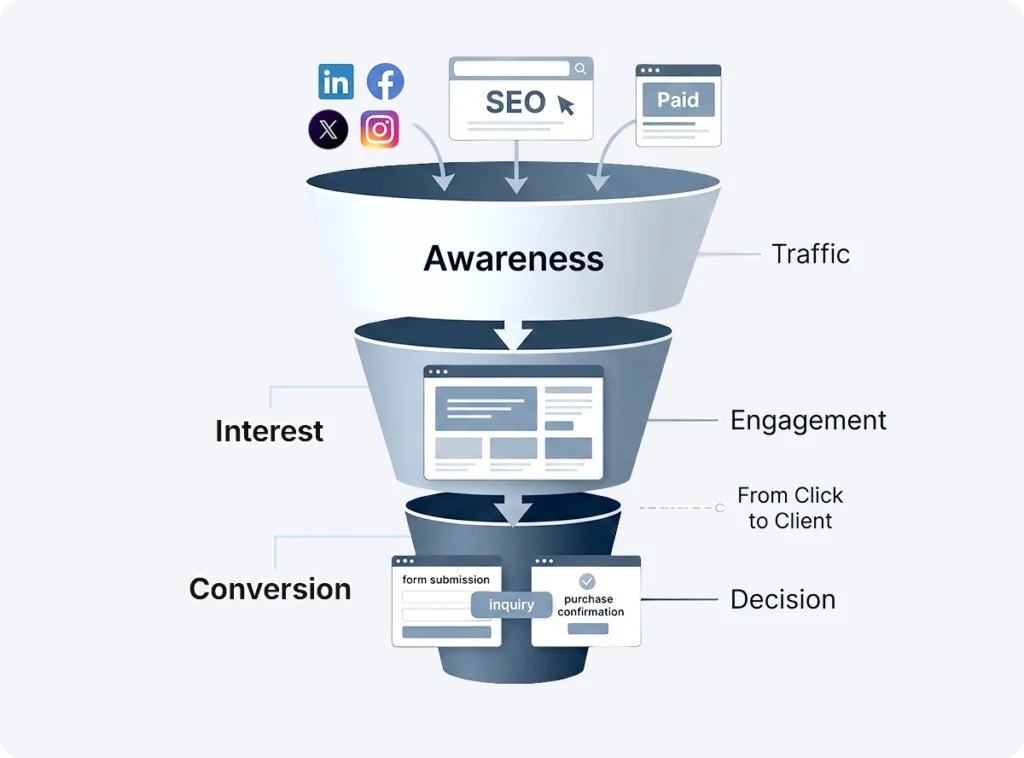
A deep breakdown of how modern digital marketing funnels actually work in real business environments, and why most businesses lose potential customers not at the “traffic” stage—but in the invisible gap between click and conversion. This guide explains each stage of the funnel, where it breaks, and how to build a system that turns attention into paying clients.
Table of Contents
Introduction: Why Funnels Matter
Most businesses misunderstand digital marketing by focusing too heavily on individual channels rather than the full customer journey. They invest in ads, SEO, or social media expecting immediate results, but often overlook how users actually move from first interaction to final purchase decision. This is where funnels become essential.
A marketing funnel is not just a conceptual model; it is a practical framework that explains how strangers become leads and how leads become customers. Without this structure, businesses tend to generate traffic without conversion clarity, resulting in wasted ad spend and inconsistent lead flow. Funnels help transform scattered marketing efforts into a predictable system that guides user behavior step by step.
Understanding funnels also shifts the focus from “getting clicks” to “guiding decisions.” This is the foundation of scalable digital marketing across SEO, paid ads, and content-driven acquisition strategies.
What Is a Marketing Funnel?
A marketing funnel is a structured journey that represents how potential customers move from awareness of a brand to taking a final action such as purchasing, booking, or enquiring. It is called a funnel because the number of users naturally decreases at each stage as only a fraction of people continue to the next step.
At a practical level, the funnel helps businesses understand not just where traffic comes from, but how effectively that traffic is being converted into meaningful business outcomes. Instead of treating all visitors the same, a funnel separates users based on intent, behavior, and readiness to act.
In modern digital ecosystems that include Google Ads, SEO, social media, and content marketing, funnels are the connecting structure that ensures all channels contribute to a unified conversion path rather than operating independently.
The 4 Stages of the Funnel
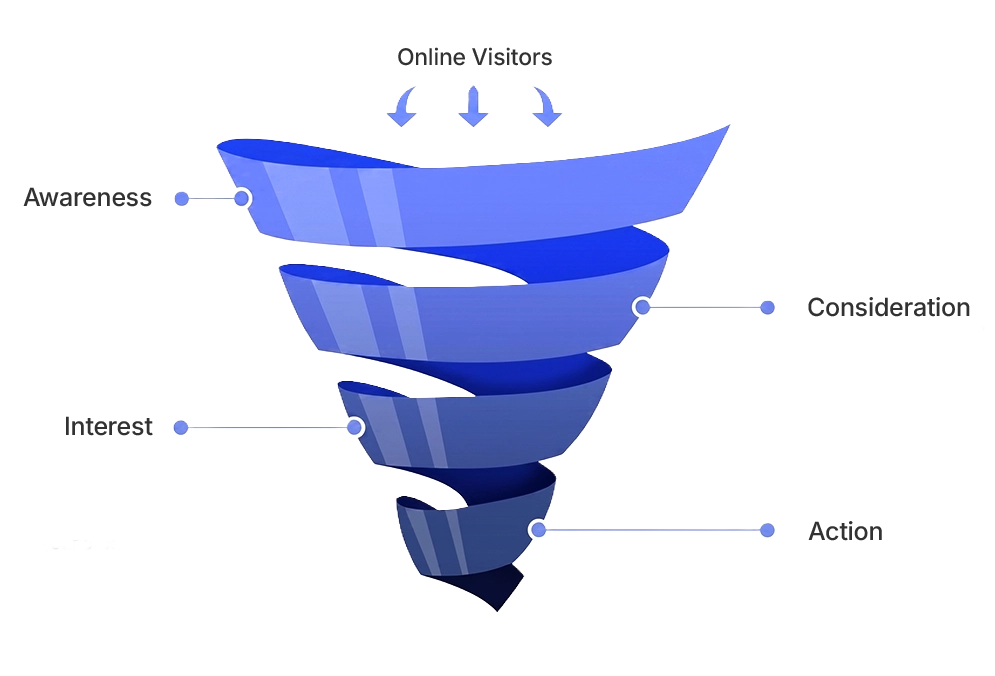
Every effective marketing funnel can be broken down into four core stages that reflect the psychological journey of a customer.
Awareness
The awareness stage is where users first discover your business, often through ads, search engines, social media, or content. At this point, they may not have a defined intent to buy, but they are becoming aware of a problem or solution.
This stage is primarily driven by visibility strategies such as SEO content, Google Ads, and social media reach campaigns. The goal is not immediate conversion but capturing attention and introducing the brand in a relevant context.
Interest
Once awareness is established, users begin to explore more details. They may visit your website, read service pages, or engage with content that helps them understand your offering better.
This stage is where trust begins to form. Businesses that fail here often lose users due to unclear messaging or weak value communication. The goal is to maintain engagement and guide users deeper into the funnel through informative and structured content.
Decision
In the decision stage, users actively compare options and evaluate whether your business is the right choice. They are no longer just browsing—they are assessing credibility, pricing, and differentiation.
This is where strong positioning, testimonials, case studies, and clear value propositions become critical. If the messaging is unclear or the website experience lacks confidence-building elements, users often drop off at this stage.
Action
The action stage is where conversion happens. This could be a purchase, a lead form submission, a call booking, or any other measurable business outcome.
At this point, friction must be minimized. Clear calls-to-action, simple forms, and fast-loading pages all contribute to improving conversion rates. Even small improvements at this stage can significantly impact overall campaign performance.
What Happens Between Click and Conversion
The most misunderstood part of digital marketing is what happens after the click. Many businesses assume that once a user clicks on an ad or search result, the hard work is done. In reality, the click is only the beginning of a decision-making process.
After clicking, users evaluate relevance, credibility, clarity, and trust within seconds. If the landing page fails to confirm their expectations or guide them clearly, they exit without converting. This is why two businesses with identical traffic can have completely different results—because the post-click experience determines conversion success.
Understanding this gap is essential for improving ROI in both SEO and paid advertising campaigns.
Where Most Funnels Break
Most funnels fail not because of lack of traffic, but because of weak alignment between stages. One of the most common breakdown points is the transition between ads and landing pages, where messaging inconsistency creates confusion.
Another frequent issue is the lack of structured nurturing between interest and decision stages. Users often need multiple touchpoints before converting, but businesses fail to provide follow-up systems such as email automation or remarketing campaigns.
Funnels also break when tracking is incomplete, making it impossible to understand where users drop off. Without visibility, optimization becomes guesswork rather than a structured improvement process.
Example of a Complete Funnel
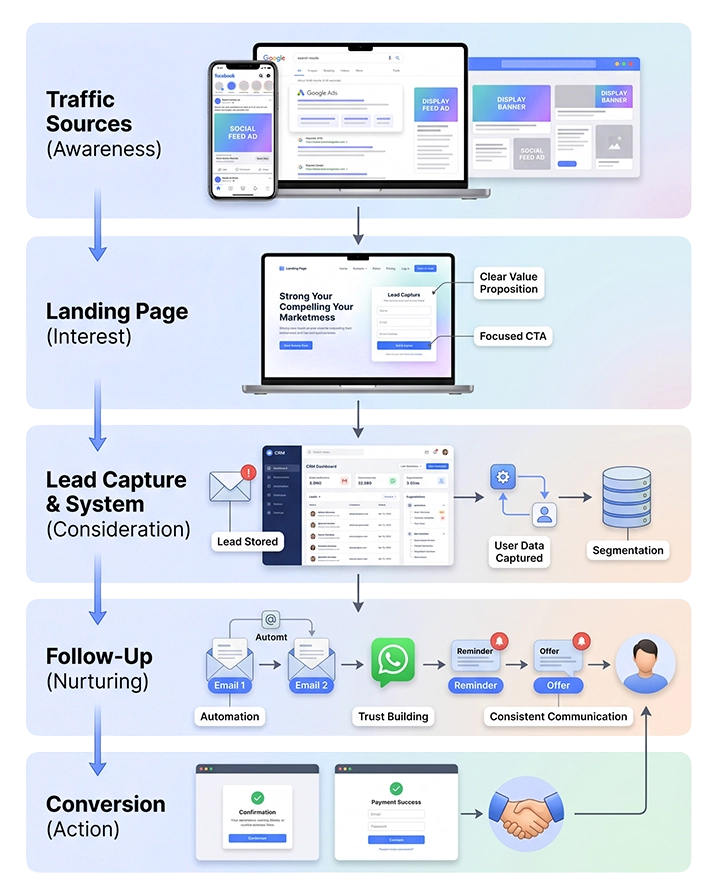
A properly structured funnel connects every stage into a seamless user journey.
A typical example starts with targeted ads or SEO content that drives users into a focused landing page. This landing page then communicates value clearly and encourages a specific action such as filling out a form or booking a consultation.
After the initial interaction, follow-up systems such as email sequences or remarketing ads continue to nurture the user, reinforcing trust and increasing conversion probability over time.
Tools Used in Each Stage
Each stage of the funnel relies on different tools and systems to function effectively. Awareness is often supported by platforms like Google Ads, SEO tools, and social media scheduling systems that help generate visibility.
Interest and decision stages rely heavily on website builders, landing page systems, and content management platforms that shape user experience and messaging clarity. Analytics tools play a key role in tracking user behavior across these stages.
The action stage is supported by conversion tools such as CRM systems, form builders, and automation platforms that capture and manage leads efficiently. Follow-up systems like email automation and remarketing tools ensure that users who do not convert immediately are not lost from the system.
How to Build Your Own Funnel
Building a functional funnel starts with understanding the customer journey from first interaction to final conversion. The first step is defining a clear offer and identifying the target audience with precision, ensuring that messaging aligns with user intent at every stage.
Once the foundation is clear, businesses should structure their website or landing pages to guide users logically from awareness to action. Traffic sources such as ads and SEO should then be aligned to match this structure, ensuring consistency in messaging and intent.
Finally, tracking and automation systems should be implemented to measure performance and maintain engagement beyond the first interaction. A funnel is not a one-time setup but a continuously optimized system that improves over time through data-driven adjustments.
Conclusion: Systems Drive Results
Funnels are not just marketing concepts; they are operational systems that determine whether a business grows predictably or struggles with inconsistent results. Without a structured funnel, even strong marketing efforts remain disconnected and inefficient.
When businesses shift from isolated campaigns to structured funnel systems, every click becomes part of a larger journey rather than a standalone metric. This shift creates clarity in performance, improves conversion rates, and allows marketing to function as a scalable business engine rather than a set of disconnected activities.