What We Fix First When a Client Comes to Luniea
A Strategic Breakdown of Our Digital Audit Approach

A structured look into how Luniea evaluates new client systems by identifying foundational gaps in traffic acquisition, website performance, and messaging clarity before making any marketing or design changes. This breakdown explains what we prioritize first, why most digital systems fail at the structural level, and how early-stage diagnosis determines long-term growth outcomes in SEO, paid ads, and conversion optimization.
Table of Contents
Introduction: What Most Clients Come With
When businesses approach Luniea, they rarely come with a blank slate. Most already have a website, some level of digital advertising activity, and at least a basic attempt at SEO or social media marketing. On the surface, these systems often look functional because traffic is being generated and content is being published consistently. However, beneath this visible activity, there is usually a deeper structural issue that prevents predictable growth.
In most cases, the core problem is not the absence of marketing efforts but the absence of alignment between strategy, execution, and conversion logic. Businesses often invest in ads without refining their website experience, or they build visually appealing websites without considering how users actually arrive and convert. This disconnect is what leads to inconsistent leads, high acquisition costs, and unpredictable performance across channels like Google Ads, SEO, and social media marketing.
Understanding what most clients come with is essential because it defines the starting point of our entire diagnostic approach. Instead of assuming what needs to be fixed, we first evaluate how the entire digital ecosystem is functioning as a connected system rather than isolated parts.
The First Step: Understanding the Business
Before touching any marketing asset, campaign, or website element, the first step is always understanding the business itself at a structural level. This includes how the business generates revenue, who the actual target audience is, what the core offer looks like, and how the brand currently positions itself in the market.
Many digital problems originate from misalignment between business reality and digital representation. For example, a company may position itself as a premium service provider, but its website messaging or ad targeting may attract price-sensitive users. This creates friction at every stage of the funnel, resulting in poor conversion rates regardless of traffic quality.
At Luniea, this phase is not treated as a formality but as a critical diagnostic stage. Without understanding the business model, any SEO strategy, PPC campaign, or website redesign becomes guesswork. The goal is to align digital execution with business intent before any optimization begins.
The 3 Core Areas We Analyze First
Every new client system is broken down into three foundational layers. These layers determine whether a business is structurally ready for scalable digital growth or whether it requires foundational rebuilding before performance marketing can succeed.
1. Traffic (Ads & SEO)
The first layer we analyze is how users are entering the system. This includes both paid traffic from platforms like Google Ads and organic traffic from SEO efforts. The focus here is not just volume but quality, intent, and alignment with business goals.
In many cases, businesses attract traffic that is either too broad or misaligned with their actual service offering. This often happens when keyword strategies are built around search volume rather than conversion intent. As a result, websites receive visitors who are researching rather than ready to take action, which lowers lead generation efficiency.
We also evaluate whether SEO efforts are structured around topical authority, semantic search relevance, and AI-driven search behavior, especially as modern search engines increasingly rely on context rather than exact keyword matching.
2. Website (UX & Conversion)
The second layer is the website experience itself, which acts as the conversion engine for all incoming traffic. Even strong traffic sources cannot compensate for a poorly structured website experience. This is where most businesses lose potential leads without realizing it.
We evaluate how users move through the website, how quickly they understand the value proposition, and whether the structure guides them toward a clear action. A common issue is websites that prioritize design aesthetics over conversion clarity, resulting in visually appealing but functionally weak experiences.
We also assess mobile responsiveness, page speed, content hierarchy, and call-to-action placement, since these factors directly influence user behaviour in both SEO and paid ad traffic environments.
3. Offer & Messaging
The third and often most overlooked layer is the clarity of the offer and messaging. Even with strong traffic and a well-designed website, unclear messaging can significantly reduce conversion rates.
We analyze whether the business value proposition is clearly communicated within the first few seconds of user interaction. This includes evaluating headlines, service descriptions, positioning statements, and trust-building elements.
In many cases, businesses struggle not because their services lack demand, but because their messaging fails to communicate differentiation. When users cannot immediately understand why they should choose one provider over another, they typically exit without taking action.
Common Issues We See
Across multiple industries, certain patterns consistently appear during our initial audits. One of the most common issues is fragmented digital strategy, where SEO, ads, and website design operate independently without a unified conversion structure. This leads to inconsistent user experiences and inefficient lead generation.
Another frequent issue is over-reliance on traffic without conversion optimization. Businesses often focus heavily on increasing clicks or impressions while ignoring how effectively those clicks are being converted into leads or customers. This creates a situation where marketing performance appears active but business impact remains limited.
We also commonly see unclear messaging hierarchy, where users are required to “figure out” what the business does instead of being guided clearly through structured content. This increases cognitive load and reduces conversion probability significantly.
Our Audit Process Explained
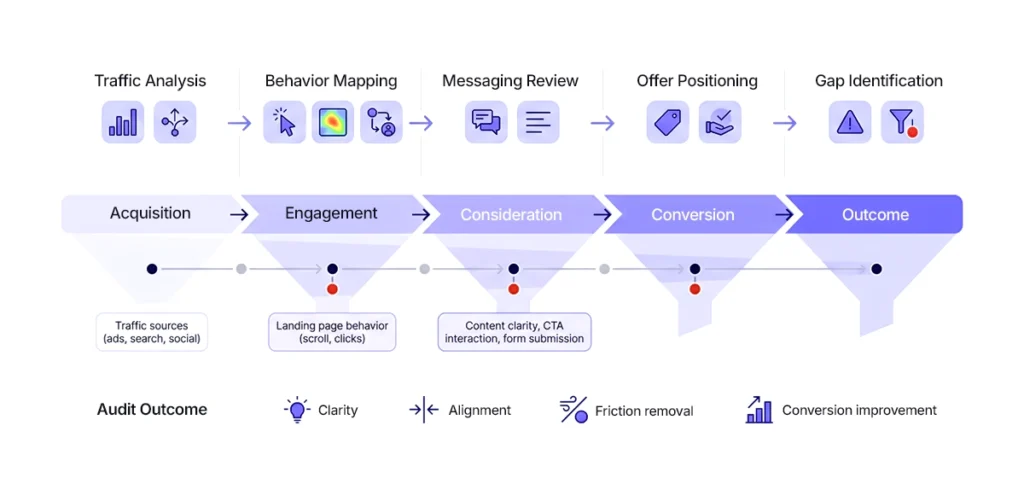
The Luniea audit process is designed to identify structural gaps before recommending any execution changes. It is not based on surface-level observations but on a layered evaluation of how each component of the digital ecosystem interacts with the others.
The process begins with traffic analysis, followed by behavioral mapping on the website, and then a detailed review of messaging clarity and offer positioning. Once these layers are mapped, we identify friction points where users drop off or lose intent.
A simplified visualization of this process typically looks like a flow from acquisition to engagement to conversion, where each stage is tested for alignment and consistency.
What We Fix First (Priority Framework)
When working with a new client, not all problems are addressed at the same time. Prioritization is critical because fixing the wrong layer first often leads to wasted effort and unclear results.
The first priority is always conversion clarity. If users do not understand the offer or fail to take action on the website, no amount of traffic optimization will create sustainable results. This is why messaging and landing experience often take precedence over scaling ads or expanding SEO efforts.
The second priority is traffic quality alignment. Once the conversion path is clear, we ensure that the right users are being attracted through ads and organic search. This prevents wasted spend and improves lead quality significantly.
Only after these foundations are stable do we focus on scaling, automation, and advanced optimization strategies.
Quick Wins vs Long-Term Fixes
In every audit, we separate issues into two categories: quick wins and long-term structural fixes. Quick wins are improvements that can immediately enhance performance, such as refining headlines, adjusting ad targeting, or improving call-to-action visibility.
Long-term fixes involve deeper system restructuring, such as rebuilding landing pages, redefining SEO architecture, or redesigning conversion funnels. These changes take more time but create sustainable performance improvements that scale with the business.
This separation is important because it allows businesses to see early improvements while still committing to foundational restructuring where necessary.
Example: Before and After Improvements
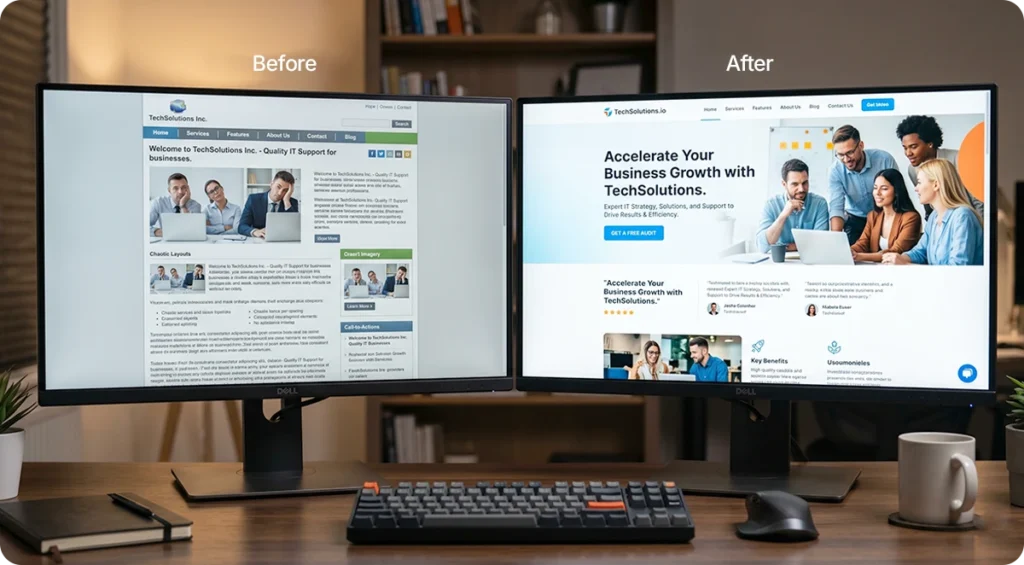
In a typical client scenario, the “before” state often includes multiple disconnected systems. Ads may be running without clear landing page alignment, SEO content may exist without targeting strategic intent, and the website may lack a structured conversion path.
After applying a structured audit and fixing priority areas, the “after” state usually reflects a more aligned system where traffic sources match user intent, landing pages communicate value clearly, and conversion pathways are simplified and measurable.
The most significant improvement is not just in metrics but in predictability. Businesses begin to understand which inputs lead to results, allowing them to scale marketing with confidence rather than uncertainty.
Conclusion: Fix the Foundation First
Effective digital growth does not start with scaling ads or producing more content. It starts with understanding whether the underlying system is structurally capable of converting attention into business outcomes. Without this foundation, even the most advanced marketing strategies will struggle to deliver consistent results.
At Luniea, every client engagement begins with this principle: fix the foundation first. Once traffic, website experience, and messaging are aligned, every subsequent optimization becomes more effective, more measurable, and more scalable. This approach ensures that growth is not just achieved, but sustained over time through a system that is built for clarity, performance, and long-term digital stability.