SEO vs Paid Ads: Where Should You Invest First?
A clear, strategy-focused breakdown of one of the most common questions in digital marketing: should a business invest in SEO or paid advertising first? This guide explains how both channels work, how they differ in speed, cost, and scalability, and why the right answer depends on your business stage—not a universal rule.
Table of Contents
Introduction: The SEO vs Ads Debate
One of the most repeated questions in digital marketing is whether a business should invest in SEO or paid advertising first. This debate exists because both channels promise visibility, traffic, and leads—but they operate in completely different ways and timelines. Many businesses expect a single correct answer, but in reality, the decision depends on business maturity, budget flexibility, and growth objectives.
SEO and paid ads are not competing strategies; they are fundamentally different systems that solve different problems. SEO builds long-term visibility and authority, while paid ads deliver immediate traffic and controlled scalability. The challenge arises when businesses treat them as interchangeable rather than complementary.
Understanding how each system works is essential before deciding where to invest first. Without this clarity, businesses often spend money on the wrong channel at the wrong stage, leading to frustration and inconsistent results.
What Is SEO (Search Engine Optimization)?
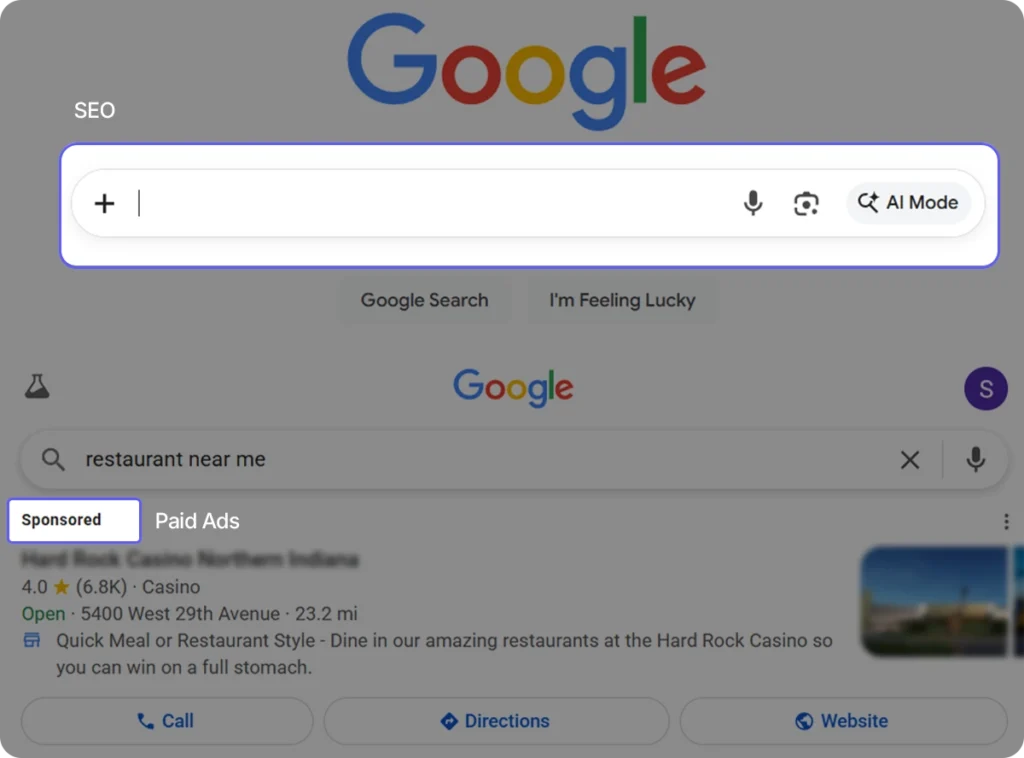
Search Engine Optimization (SEO) is the process of improving a website’s visibility in organic search results on platforms like Google. The goal is to attract consistent, non-paid traffic by ranking for relevant keywords that users actively search for.
SEO works by optimizing multiple elements such as website structure, content quality, keyword relevance, technical performance, and backlinks. Over time, search engines evaluate these signals to determine how useful and trustworthy a website is for specific search queries.
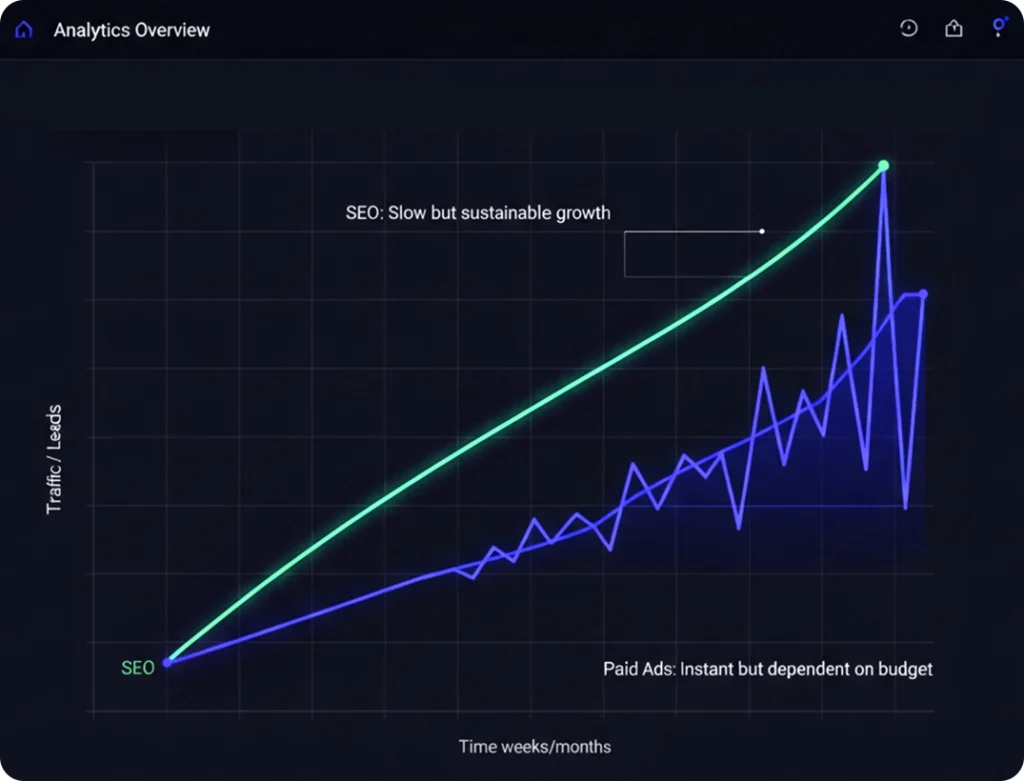
Unlike paid ads, SEO does not generate instant traffic. Instead, it builds long-term digital equity, where rankings and visibility grow gradually but become more stable and cost-efficient over time.
What Are Paid Ads (Google Ads, PPC)?
Paid advertising, often referred to as PPC (Pay-Per-Click), includes platforms like Google Ads where businesses pay to appear in front of targeted audiences. These ads are displayed instantly based on keyword targeting, audience behavior, or demographic filters.
The primary advantage of paid ads is speed. Businesses can appear at the top of search results or social feeds almost immediately after launching a campaign. This makes paid advertising highly effective for generating quick traffic, testing offers, or promoting time-sensitive campaigns.
However, paid ads operate on a budget-dependent model. Once spending stops, visibility disappears, making it a continuous investment rather than a long-term asset.
Key Differences Between SEO and Paid Ads
While SEO and paid ads both aim to generate traffic and leads, they differ significantly in execution and long-term impact. The most important differences come down to speed, cost structure, and scalability.
Speed
SEO is a long-term strategy that typically takes time to build momentum. It may take weeks or months for content to rank and generate consistent traffic. Paid ads, on the other hand, deliver immediate visibility as soon as campaigns are launched.
This makes paid ads more suitable for businesses that need quick results, while SEO is better suited for sustainable growth over time.
Cost
SEO generally requires upfront investment in content, optimization, and technical improvements, but it does not require ongoing payment for each visitor. Paid ads operate on a continuous cost model where every click has a price, and budgets directly influence visibility.
Over time, SEO can become more cost-efficient, while paid ads require ongoing funding to maintain performance levels.
Scalability
SEO scales gradually as content ranks for more keywords and builds authority across search engines. Once established, it can generate consistent traffic without proportional increases in cost.
Paid ads scale faster but require increased budget allocation. Scaling PPC campaigns often means increasing spend, optimizing conversions, and managing higher competition costs.
Pros and Cons of SEO
SEO offers strong long-term benefits but comes with its own limitations.
The primary advantage of SEO is sustainability. Once a website ranks well, it can generate consistent organic traffic without ongoing ad spend. It also builds brand authority and trust because users tend to trust organic search results more than advertisements.
However, SEO requires time, consistency, and strategic execution. Results are not immediate, and competition in high-value industries can make ranking more challenging. Algorithm updates can also affect performance, requiring continuous optimization.
Pros and Cons of Paid Advertising
Paid advertising provides speed and control, making it a powerful tool for immediate visibility and lead generation.
The biggest advantage of paid ads is instant traffic. Businesses can test offers, target specific audiences, and generate leads quickly. It also provides precise control over targeting, budget, and performance tracking.
The main limitation is cost dependency. Once the budget is paused, traffic stops immediately. Additionally, paid ads require ongoing optimization to remain efficient, especially in competitive industries where cost-per-click can increase over time.
When to Choose SEO
SEO is the right choice when a business is focused on long-term growth and wants to build a sustainable digital presence. It is especially effective for businesses that can invest time in content creation and technical optimization without needing immediate results.
It is also ideal for industries where users frequently search for solutions before making decisions, such as services, consulting, education, and local businesses. In these cases, ranking organically can significantly reduce customer acquisition costs over time.
When to Choose Paid Ads
Paid ads are the better option when a business needs immediate visibility or fast lead generation. This is especially useful for new businesses, product launches, or time-sensitive offers where waiting for SEO results is not practical.
Paid advertising is also effective for testing messaging, offers, and audiences quickly. It allows businesses to gather real-time data and optimize campaigns based on actual user behavior.
The Best Strategy: Combining Both
In most real-world scenarios, the most effective strategy is not choosing between SEO and paid ads, but combining both into a unified growth system. Paid ads can provide immediate traffic and data insights, while SEO builds long-term organic visibility and reduces dependency on paid channels.
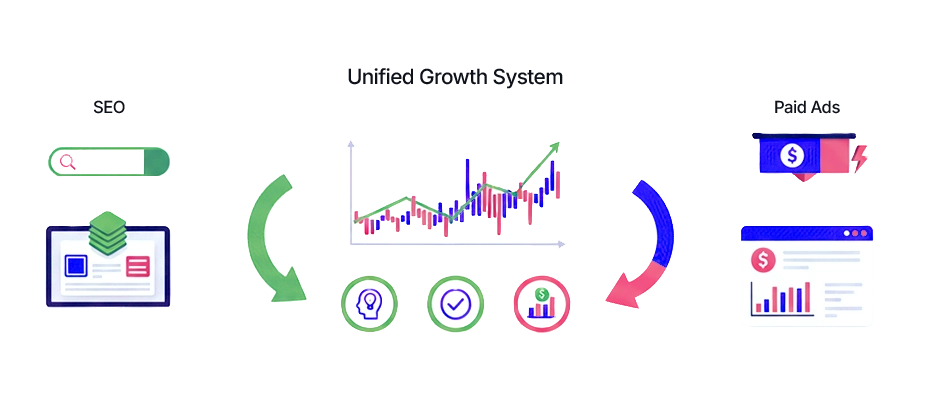
When both systems work together, businesses can capture users at different stages of intent. Paid ads can target high-intent users immediately, while SEO builds authority and captures long-term search demand.
This combination creates a balanced marketing system where short-term performance and long-term growth support each other.
Conclusion: It Depends on Your Business Stage
There is no universal answer to whether SEO or paid ads should come first. The right choice depends on business stage, budget, and urgency. Early-stage businesses often benefit from paid ads to generate quick traction, while established businesses benefit more from SEO for long-term stability.
In practice, the strongest digital strategies do not treat SEO and paid ads as alternatives. They treat them as interconnected systems that serve different roles within the same funnel. Businesses that understand this distinction are able to build more predictable, scalable, and cost-efficient growth models over time.