Why Your Ads Don’t Bring Consistent Leads

A practical breakdown of why your ads don’t bring consistent leads and why many businesses struggle with unpredictable results from Google Ads and paid advertising campaigns. This guide explains the most common lead generation mistakes, why ad campaigns become inconsistent, and how to build a structured advertising system that generates more reliable business outcomes.
Table of Contents
Introduction: The Problem With Inconsistent Lead Generation
Many businesses invest heavily in Google Ads, Facebook Ads, and paid marketing campaigns expecting a steady flow of leads and inquiries. However, after running campaigns for some time, they often notice a frustrating pattern: some weeks generate strong results while other periods produce little to no qualified leads.
This inconsistency creates confusion because the ads may still be receiving clicks, impressions, and traffic. Businesses then begin increasing budgets, changing creatives, or launching new campaigns without understanding the real issue behind the inconsistent performance.
Understanding why your ads don’t bring consistent leads is important because the problem is usually not caused by a single factor. In most cases, inconsistency happens when multiple parts of the advertising system are disconnected. A successful advertising campaign is not only about getting visibility. It is about building a reliable lead generation structure that consistently converts traffic into measurable business results.
What Consistent Leads Actually Mean
Consistent leads do not simply mean receiving inquiries occasionally. A consistent lead generation system produces predictable and repeatable results over time. This means:
- Stable lead flow
- Better lead quality
- Controlled customer acquisition
- Predictable conversion performance
- Sustainable advertising ROI
Businesses that understand why your ads don’t bring consistent leads usually discover that campaign stability depends on structure rather than short-term optimization tricks. Consistency is created when targeting, messaging, landing pages, offers, and tracking systems work together properly.
Why Your Ads Don’t Bring Consistent Leads
There are several major reasons why your ads don’t bring consistent leads, even when campaigns appear active on the surface. Many businesses focus only on ad visibility while ignoring the systems required to convert users consistently after the click.
The Biggest Problems in Paid Advertising Campaigns
Paid advertising can generate fast visibility, targeted traffic, and high-quality leads when campaigns are structured correctly. However, many businesses struggle to achieve stable results because their campaigns focus only on generating clicks instead of building a complete conversion system.
When businesses ask why their ads don’t bring consistent leads, the issue is rarely just the advertisement itself. In most cases, the real problem lies in the overall strategy, targeting accuracy, landing page experience, tracking setup, and message alignment.
Weak Audience Targeting
One of the most common reasons paid advertising campaigns fail is poor audience targeting. Even well-designed ads cannot produce reliable results if they are shown to the wrong people.
Many campaigns target audiences that are too broad or attract users with low purchase intent. This often increases traffic volume while reducing lead quality. Users may click the advertisement out of curiosity, but they are unlikely to take meaningful action because the service does not match their actual needs.
Common targeting mistakes include broad keyword selection, incorrect demographic settings, weak audience segmentation, irrelevant traffic sources, and poor geographic targeting. These issues typically result in wasted ad spend and inconsistent campaign performance.
High-performing advertising campaigns focus on attracting high-intent users rather than maximizing clicks alone. The goal is not simply to increase traffic, but to reach users who are actively searching for a solution and are more likely to convert into leads or customers.
Poor Landing Page Experience
Another major reason why ads don’t bring consistent leads is the disconnect between ad performance and landing page experience. Many businesses succeed in generating clicks but fail to convert visitors after they arrive on the website.
A landing page plays a critical role in the conversion process. If the page is slow, confusing, difficult to navigate, or poorly optimized for mobile users, visitors often leave before taking action.
Several factors commonly reduce landing page performance, including weak headlines, cluttered layouts, unclear messaging, poor mobile responsiveness, missing trust signals, and the absence of a strong call-to-action. In some cases, businesses overload landing pages with excessive information, making it difficult for users to identify the next step.
An effective landing page should maintain message consistency with the advertisement while guiding visitors toward one clear conversion goal. The experience should feel simple, focused, and trustworthy from the moment the user clicks the ad.
Inconsistent Messaging
Consistency between advertisements and landing pages is essential for building user trust. When an ad communicates one promise but the landing page presents a different message, users often become uncertain and leave without converting.
This alignment issue is frequently overlooked in paid advertising campaigns. Businesses may create attractive advertisements, but if the landing page does not reinforce the same offer, tone, or value proposition, conversion rates usually decline.
Consistent messaging improves user confidence, strengthens brand credibility, and increases lead quality. It also helps advertising platforms better understand campaign relevance, which can contribute to stronger long-term performance and improved campaign stability.
Businesses struggling with inconsistent lead generation often underestimate how important message alignment is throughout the entire customer journey.
No Conversion Tracking
Without proper tracking systems, businesses cannot accurately measure advertising performance or make informed optimization decisions. This creates significant visibility problems because there is no reliable way to understand what is actually generating results.
Many campaigns operate without clear data on which advertisements produce leads, which keywords drive conversions, which audiences perform best, or where the advertising budget is being wasted.
Effective tracking systems usually include Google Ads conversion tracking, Google Analytics integration, call tracking, form tracking, and CRM integration. These systems provide the data needed to improve targeting, optimize campaigns, and increase return on investment over time.
Advertising without conversion tracking is similar to making decisions without measurable feedback. Consistent lead generation depends heavily on accurate performance data and ongoing optimization.
Budget Without Strategy
A common misconception in paid advertising is that increasing the budget automatically improves campaign results. In reality, higher spending cannot solve deeper structural problems within the campaign.
Many businesses attempt to fix inconsistent lead generation by simply allocating more money to advertisements. However, if the campaign already suffers from weak targeting, poor messaging, low conversion rates, or ineffective landing pages, additional spending often increases inefficiency rather than improving performance.
Successful advertising campaigns depend on strategy first and budget second. Businesses that focus on optimization, audience quality, and conversion systems typically achieve better long-term results than those relying solely on increased ad spend.
Wrong Campaign Objectives
Campaign objectives have a major influence on advertising performance because they determine how platforms optimize ad delivery.
For example, campaigns optimized only for website traffic may generate large numbers of clicks without attracting qualified leads. While traffic metrics may appear strong, the actual business outcomes often remain weak.
Businesses should structure campaigns around meaningful objectives such as lead generation, inquiries, bookings, or purchases. Aligning campaign goals with actual business outcomes helps advertising platforms deliver ads to users who are more likely to complete valuable actions.
Choosing the wrong optimization goal can significantly reduce lead quality and make campaign performance inconsistent over time.
Weak Offers
Even highly optimized advertising campaigns struggle when the offer itself lacks clarity or value. Users need a compelling reason to take action, especially in competitive markets where multiple businesses are promoting similar services.
Strong offers clearly communicate value, explain specific outcomes, address customer problems directly, and create relevance or urgency. A clear and focused offer helps users quickly understand why they should choose the business over competitors.
Weak or generic offers reduce both click quality and conversion rates because users fail to see a meaningful benefit in taking the next step. In many cases, improving the offer itself can significantly increase advertising performance without increasing the campaign budget.
Why Clicks Are Not the Same as Leads
One of the biggest misconceptions in paid advertising is assuming that clicks automatically create business growth. Clicks only indicate attention. Leads indicate action and intent. This distinction is critical when understanding why your ads don’t bring consistent leads. A campaign may generate:
High impressions | Strong click-through rates | Large traffic volume
While still producing poor lead quality because the post-click experience is weak. Successful advertising focuses on conversions rather than traffic volume alone.
The Connection Between Ads and Landing Pages
Ads and landing pages should function as one connected system. The ad creates interest. The landing page builds trust and drives conversion. If either side of this system is weak, overall campaign performance becomes inconsistent. A strong landing page usually includes:
- Clear headline
- Focused message
- Trust signals
- Conversion-focused structure
- Strong CTA
- Mobile optimization
- Fast loading speed
Businesses trying to solve why your ads don’t bring consistent leads often improve campaigns significantly after optimizing landing pages rather than changing ads alone.
What a Consistent Lead Generation System Looks Like
A reliable advertising system combines multiple connected components.
Step 1: Targeted Traffic
Ads attract high-intent users.
Step 2: Message Alignment
The landing page matches the ad expectation.
Step 3: Trust Building
Reviews, testimonials, and proof reduce hesitation.
Step 4: Conversion
Users are guided toward inquiry or booking actions.
Step 5: Tracking & Optimization
Performance data helps continuously improve campaigns.
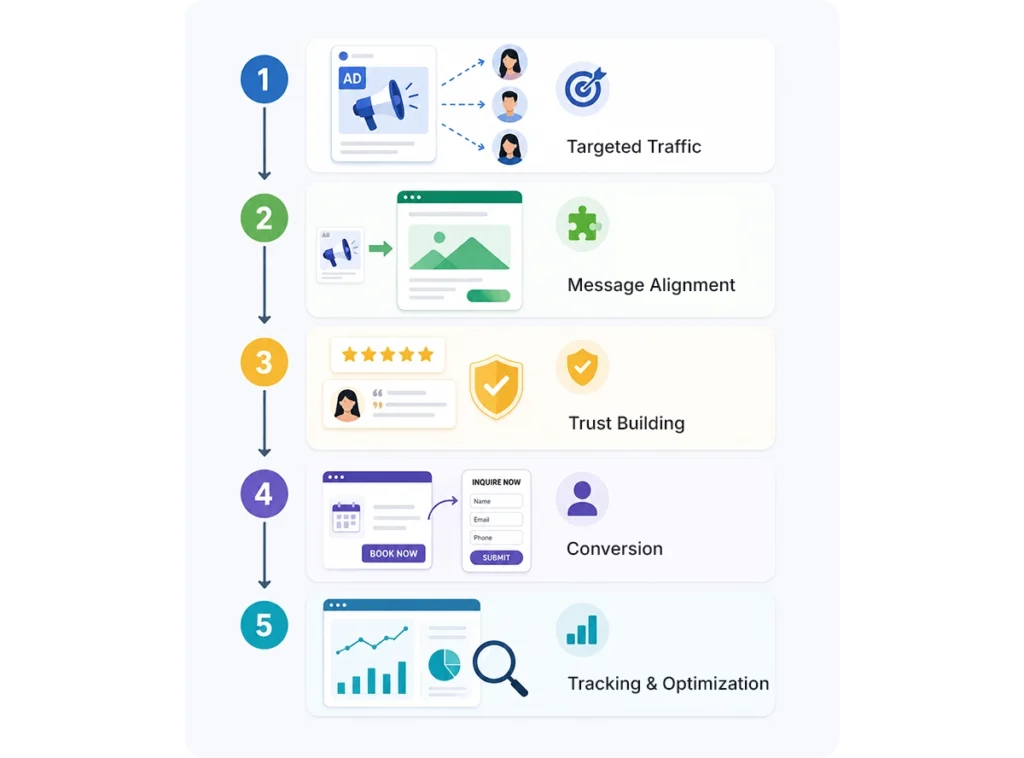
When all these systems work together, lead generation becomes far more stable and predictable.
Common Mistakes Businesses Make With Ads
These problems create unstable advertising performance over time. Businesses frequently make several advertising mistakes that reduce lead consistency:
- Focusing only on clicks
- Ignoring landing page optimization
- Using broad targeting
- Running ads without tracking
- Sending traffic to generic homepages
- Constantly changing campaigns too quickly
- Scaling budgets before fixing conversion issues
- Using inconsistent messaging
How to Improve Ad Consistency and Lead Quality
Businesses can improve campaign consistency by focusing on the entire lead generation system rather than ads alone.
Important improvements include:
- Refining audience targeting
- Improving landing pages
- Strengthening CTA sections
- Optimizing mobile experience
- Adding trust signals
- Implementing conversion tracking
- Testing offers systematically
- Aligning ad and landing page messaging
Understanding why your ads don’t bring consistent leads allows businesses to identify where the conversion process is breaking down.
Consistency comes from optimization across the entire funnel.
SEO, Content, and Paid Ads Connection
Paid advertising does not operate independently.
“SEO helps build long-term search visibility.
Content marketing improves authority and trust.
Landing pages support conversion optimization.
Paid ads generate targeted traffic quickly.”
When these systems work together, businesses create stronger and more sustainable lead generation performance. Without proper website structure and conversion systems, even well-managed ad campaigns struggle to maintain consistency.
Conclusion: Consistency Comes From Systems
Many businesses struggle with why your ads don’t bring consistent leads because they focus only on ads rather than the entire conversion system. A successful advertising strategy depends on:
- Strong targeting
- Clear messaging
- High-converting landing pages
- Proper tracking
- Structured optimization
When these elements work together, paid advertising becomes far more predictable and efficient. The goal is not simply to generate clicks. The goal is to build a system where advertising consistently produces qualified leads and measurable business growth over time.